GrabFood in Thailand: Platforms, Fees, Schemes and Calendar
How the Thai delivery market splits, what Grab really deducts, what the government co-payment rounds changed for commission, and the dates that move demand.

GrabFood held 47% of Thailand's food delivery GMV in 2025; its commission rate is set in each merchant's contract and not published, several other deductions sit between an order and your payout, and the government co-payment rounds of 2025 and 2026 charged participating restaurants 7% or 9% on qualifying orders.
Thailand is the fastest growing food delivery market in Southeast Asia, and one of the hardest to read from the outside. Two platforms hold almost all of it. The money between an order and your bank account passes through several deductions, and only one of them is fixed in your contract. And government co-payment rounds have, twice in a year, brought commission to half its usual rate for restaurants that signed up in time.
The Thai platform map
The market consolidated in 2025. foodpanda stopped operating in Thailand on 23 May 2025, after thirteen years, and transferred its customers, merchants and riders to Robinhood.
| Platform | Share of 2025 delivery GMV | Notes |
|---|---|---|
| GrabFood | 47% | The largest platform. Grab Thailand's revenue grew to THB 23.3 billion in 2025. |
| LINE MAN Wongnai | 41% | Thailand only. More than doubled its share since 2020 and posted its first net profit in 2025. |
| ShopeeFood | about 10% | Up from 7% the year before. |
| Robinhood | the remainder | Now run by Purple Ventures (Yip In Tsoi Group), mainly in Bangkok and surrounding provinces, aiming for profitability in 2026. |
Thailand's delivery GMV grew from about USD 4.2 billion in 2024 to about USD 5.1 billion in 2025, a 22% rise and the fastest in the region. The growth is concentrating: Grab and LINE MAN together went from 86% of the market in 2024 to close to 90% in 2025.
What this means for you. GrabFood is the largest platform in Thailand, and the one this guide is about. An account maintained on a schedule keeps converting: its prices, photos and menu stay true to what you serve. An account left as it was on the day it was set up drifts, and its orders drift with it. Review yours on a fixed schedule.
What the platform actually takes
GrabFood commission in Thailand is negotiated merchant by merchant and is not published. Grab Thailand's merchant guidance has been reported to cite an average of about 30% to 35% before VAT, but your rate is the one in your contract. Any single figure you read elsewhere is someone else's contract.
What can be described is every line that sits between an order and your payout, and how to work out your own numbers. On Thai GrabFood accounts, the merchant app shows these deductions:
| Deduction | What it is | Your control |
|---|---|---|
| Commission | The contracted percentage on each order | At contract renewal, or through a government scheme |
| Step-up commission | An extra line linked to Grab campaigns you have joined | Indirect: it follows your campaign choices |
| Merchant-funded discounts | The discounts you set yourself | Complete |
| Marketing success fee | A fee on orders attributed to a Grab campaign | Decided when you join a campaign |
| Advertising | What you spend on Grab ads | Complete |
These lines are what the merchant app displays; Grab does not document them publicly. Check your own payment details: the names and the way they are shown can change.
Work out your own two numbers
Your real commission rate. Open four completed orders of different sizes in your payment details. For each one, divide the commission deducted by the order value minus any discount you funded. If the four results agree, that is your real rate. If they do not, or if they differ from the rate printed next to the commission line, ask merchant support before you build prices on it.
Your all-in take rate. For a full month, divide your earnings by your gross sales. That is what you actually keep. Run it every month. It moves when your campaign mix moves, even when your contract has not changed.
The line that moves without a contract change
The merchant app describes step-up commission as a fee for the Grab campaigns you have joined, such as storewide discounts or lower delivery fees, meant to boost visibility and sales. It rises when you join campaigns and falls when you leave them. So the real cost of a Grab campaign is never only the discount you fund: it is the discount, plus any marketing success fee, plus the change in this line. Compare your take rate in the month before you joined with the month after. The difference is the campaign's true price.
Government co-payment schemes and their commission rate
This is specific to Thailand, and it has been the single biggest change to the fee stack in the past year.
When the Thai government runs a co-payment scheme, GrabFood has offered participating restaurants a much smaller commission on orders placed under it.
Kon La Krueng Plus (late 2025). GrabFood charged 7% to merchants who registered on 3 November 2025, the opening day, and 9% to those who registered from 4 November. Registration ran until 31 December 2025. Grab also offered incentives of up to THB 10,000, loans of up to THB 1 million, and 30 days of 0% Dine Out commission for new merchants. Grab reported one million orders within a few days, and that participating merchants' sales rose to an average of three times their normal level.
Thais Help Thais Plus 60/40 (June to September 2026). GrabFood charged 9% to merchants who signed up by 10 June 2026, with campaigns and codes worth up to THB 20,000 per store, THB 1,200 in advertising credit, and access to loans from THB 2,500 to THB 2 million. Delivery orders under the scheme ran from 15 June to 30 September 2026. Within two weeks, orders from participating Grab merchants passed THB 500 million.
How registration worked on Grab. First accept the scheme terms through the banner in GrabMerchant and check that your Tax ID matches the one registered in Thung Ngern. Then, in the Thung Ngern app, select Grab, paste your Merchant ID from GrabMerchant and confirm by OTP.
What to do now. As of October 2026, no new round has been announced. The pattern is clear, though: the best rate has twice gone to restaurants that registered first, and the announcement window was short each time. Keep your Thung Ngern registration current and your Tax ID consistent across both apps, so that you can join on day one of the next round.
Promotions, and a trap inside the free item format
Grab's self-serve promotions include whole order discounts, item discounts, bundles, delivery fee discounts and free items. They behave differently and are not interchangeable.
The free item format is useful for building basket size, and on Thai accounts it has a trap worth knowing. In the merchant tool, each free item campaign has one free item and one minimum order value. The free item has to be a priced menu row, and an item with option groups cannot be used, so a dish with a size or sauce choice needs a plain version first.
The trap: two free item campaigns do not behave like tiers. If one gives a free side above THB 450 and another gives a different item above THB 650, an order of THB 650 receives both. In our observation there is no setting that switches the lower gift off once the higher threshold is reached, so the largest baskets give away the most. Grab does not document this behaviour publicly; test it on your own account before relying on a ladder.
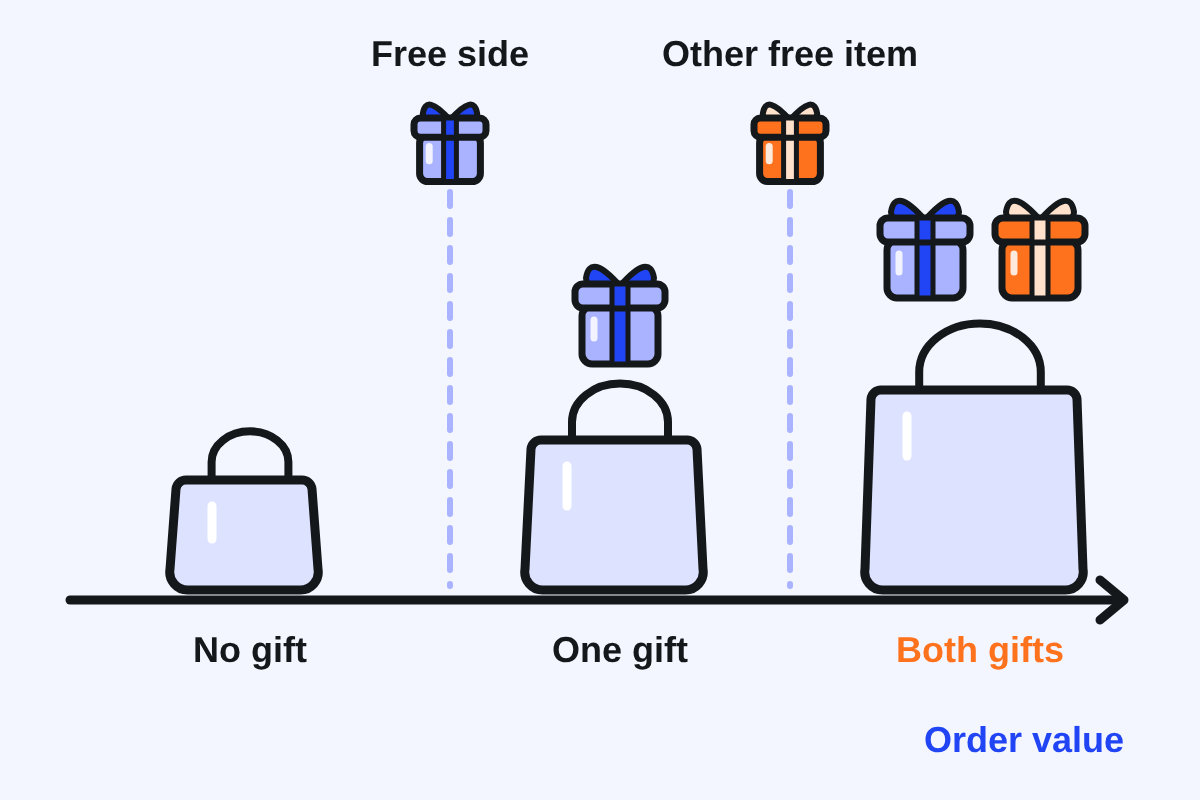
The rule. Run one free item offer, at one threshold, at a time. Choose the threshold for what it does to orders just below it, not for what it costs at the top.
On co-funded campaigns. A storewide campaign that Grab co-funds is cheaper than one you fund alone, but it is not free. Check the fee shown before you join, add the change in step-up commission afterwards, and compare your take rate before and after.
The Thai calendar
The calendar moves demand. These are the dates to plan around; how much each one moves your orders depends on your location and customers, so check your own numbers from last year before budgeting.
The vegetarian festival (kin jay). Nine days when many people change what they eat. In 2026 it runs from 10 to 18 October, and it is the most visible in Phuket. The dates follow the lunar calendar and change each year. A jay section that is live, photographed and correctly named in Thai before the first day is ready for the whole festival; one built halfway through misses most of it. Prepare a month ahead.
Tourist high season, roughly November to April. In tourist areas such as Phuket, Samui, Krabi and Chiang Mai, this is the busy period. In residential Bangkok the effect is milder. Increase advertising step by step against a minimum return, rather than doubling it.
Songkran, 13 to 15 April. Many people travel home for the holiday. A restaurant in central Bangkok and one in a provincial town can see opposite effects. Look at your own April before deciding on hours and budget.
The rainy season, roughly May to October. Heavy-rain days can change delivery demand. It is also a good window for menu work: testing prices, removing dead rows, reshooting photos, while mistakes cost less than they would in December.
Five checks for a Thai account
- Thai names. Make sure every item can be found by a customer searching in Thai. If your menu tool lets you add both Thai and English names, fill both.
- Photo coverage. Start with the dishes that already sell, then extend to every row.
- Category order. Research on simulated delivery platforms shows that what appears first changes what people choose. Do not open your menu with the lowest-margin category.
- Preparation time and delays. Order delays count in Grab's quality programs. Look at delays shift by shift in the Portal rather than as a monthly average, which can hide one or two bad services.
- Your full review history. Read reviews in the merchant app regularly, including older ones. Repeated complaints about portion, temperature or missing items usually point at something still happening.
Questions people ask
What commission does GrabFood charge restaurants in Thailand?
It is negotiated per merchant and not published. Grab Thailand's guidance has been reported to cite an average of about 30% to 35% before VAT. During government co-payment rounds, participating restaurants paid 7% or 9% on qualifying orders.
What is step-up commission on GrabFood?
An additional commission line linked to the Grab campaigns your store has joined. It moves with your campaign choices and is not in your contract.
Does foodpanda still operate in Thailand?
No. It stopped operating on 23 May 2025 and transferred its customers and merchants to Robinhood.
Is there a government co-payment scheme running now?
The Thais Help Thais Plus 60/40 round ended on 30 September 2026, and no new round had been announced as of October 2026. Keep your registration current so you can join quickly when the next one opens.
When is the vegetarian festival?
In 2026, 10 to 18 October. The dates change every year with the lunar calendar.
Do I need to register for VAT?
VAT registration applies once annual turnover exceeds THB 1.8 million. Delivery sales are part of your turnover, so a restaurant growing on delivery should talk to its accountant before crossing that line.
Do I need a Thai company to list on GrabFood?
No. Individuals can register with a Thai ID card and a bank account at Kasikorn, Krungthai or Krungsri. See the merchant account setup guide for the documents by entity type.
Keep reading: Grab Commission Fees · Grab Merchant Account Setup · Campaign checklist: keep, adjust or stop
Sources
18 sources, each claim traceable to one
- Bangkok Post, Robinhood and foodpanda Thailand announce strategic redirection (20 May 2025): www.bangkokpost.com/business/general/3030245/robinhood-and-foodpanda-thailand-announce-strategic-redirection
- Bangkok Post, Food delivery market heats up as Line Man Wongnai cuts fees (9 Jun 2026): www.bangkokpost.com/business/general/3267933/food-delivery-market-heats-up-as-line-man-wongnai-cuts-fees
- Bangkok Post, market share and GMV report citing Momentum Works (2026): www.bangkokpost.com/business/general/3190654
- Bangkok Post, Robinhood seeks profitability in 2026: www.bangkokpost.com/business/general/3124602/robinhood-seeks-profitability-in-2026
- Bangkok Post, Grab adds perks for co-pay scheme (2026): www.bangkokpost.com/business/general/3262975/grab-adds-perks-for-copay-scheme
- Bangkok Post, Food deliveries surge under co-pay scheme (4 Jul 2026): www.bangkokpost.com/business/general/3280794/food-deliveries-surge-under-copay-scheme
- Bangkok Post, Online food delivery apps compete over stimulus discounts (2025): www.bangkokpost.com/business/general/3123986/online-food-delivery-apps-compete-over-stimulus-discounts
- Grab Thailand press, GrabFood x Kon La Krueng Plus (2025): www.grab.com/th/en/press/others/grabfoodxkonlakruengplus2025
- Grab Thailand press, Kon La Krueng Plus impact (Nov 2025): www.grab.com/th/en/press/others/grab5050plusimpact
- Grab Thailand press, GrabFood x Thais Help Thais Plus (29 May 2026): www.grab.com/th/en/press/others/grabfoodthaishelpsthaisplus
- Nation Thailand, 60/40 scheme totals: www.nationthailand.com/business/economy/40069327
- Grab, Self-serve marketing manager for merchants (promo formats): www.grab.com/inside-grab/stories/self-serve-marketing-manager-merchants-msmes
- Baanlyy, Food delivery apps in Thailand (secondhand report of Grab TH GP guidance): baanlyy.com/learn/food-delivery-apps-thailand
- Tourism Authority of Thailand, Phuket Vegetarian Festival 2026: www.tourismthailand.org/Events-and-Festivals/phuket-vegetarian-festival-2026
- Thailand Revenue Department, VAT: www.rd.go.th/english/6043.html
- Grab Thailand, merchant sign-up page: www.grab.com/th/en/merchant
- PMC, Repositioning options on an experimental food delivery platform (2023): www.ncbi.nlm.nih.gov/pmc/articles/PMC10197857
- Grab PH, About Quality Hero Program (order delay metric): merchant.grab.com/en-ph/guides/ensure-safety-quality/about-quality-hero-program