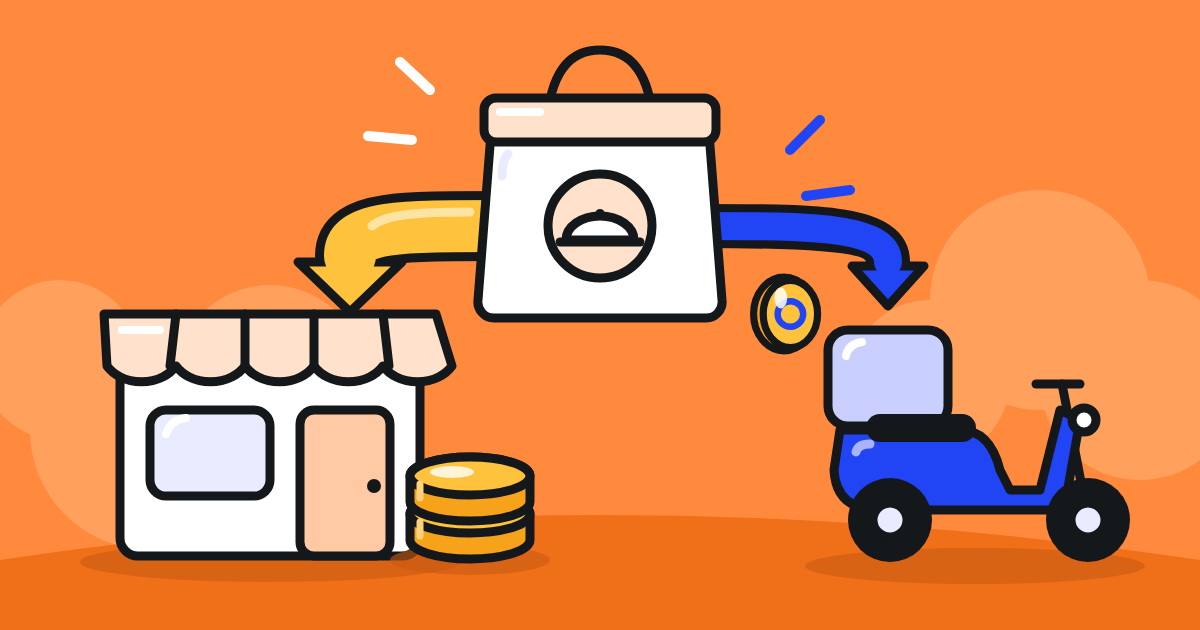
The GrabFood commission is the share of each order's value that Grab keeps before it pays your restaurant. Grab Thailand has said that, on average, it charges merchants around 15% to 30% of the order value1, in a post dated July 12th, 20212. That is a range, not your rate. Your rate depends on your sales volume and your contract type3, so the number that matters is the one written in your own merchant contract and on your own statements.
In Thailand the commission is often called GP, and Grab uses both words side by side in its own announcements4. This guide uses "commission" throughout.
How much is the GrabFood commission in Thailand?
Grab's own public answer is the range above. In the same post, Grab worked it through for a typical Thai order: an average order of around 150 to 200 baht works out to around 22.5 to 60 baht in commission5. Keep in mind that this post is from 20212. It is the clearest figure Grab has published on its standard rate in the sources this guide relies on, but it is not recent.
A guide published by a restaurant software vendor in 20266 puts GrabFood's standard rate at 20% to 30% per order7, and says new restaurants often start at 30% and can negotiate down to 20% as their order volume grows8. Read that with care. It is a vendor's summary of what restaurants report, not a rate card from Grab, and it does not say where its figures come from.
What to do: open your merchant contract and find the rate. Then check one month of statements and confirm that the commission charged matches it. If the two disagree, that is the first conversation to have with Grab.
What does the GrabFood commission pay for?
Grab explained its side of the order in the same 2021 post. On a 150 baht order with a 30% rate, Grab takes 45 baht in commission9 and the restaurant receives 105 baht, which is 70% of the order10. The delivery fee the customer pays goes to the delivery partner11.
According to Grab, most of the commission also goes to delivery partners12. What is left, if anything, covers operating costs: delivery partner insurance, cashless payment costs (Grab gives credit card charges of around 2.5% to 3% of the transaction value as an example), product improvements and customer service13.
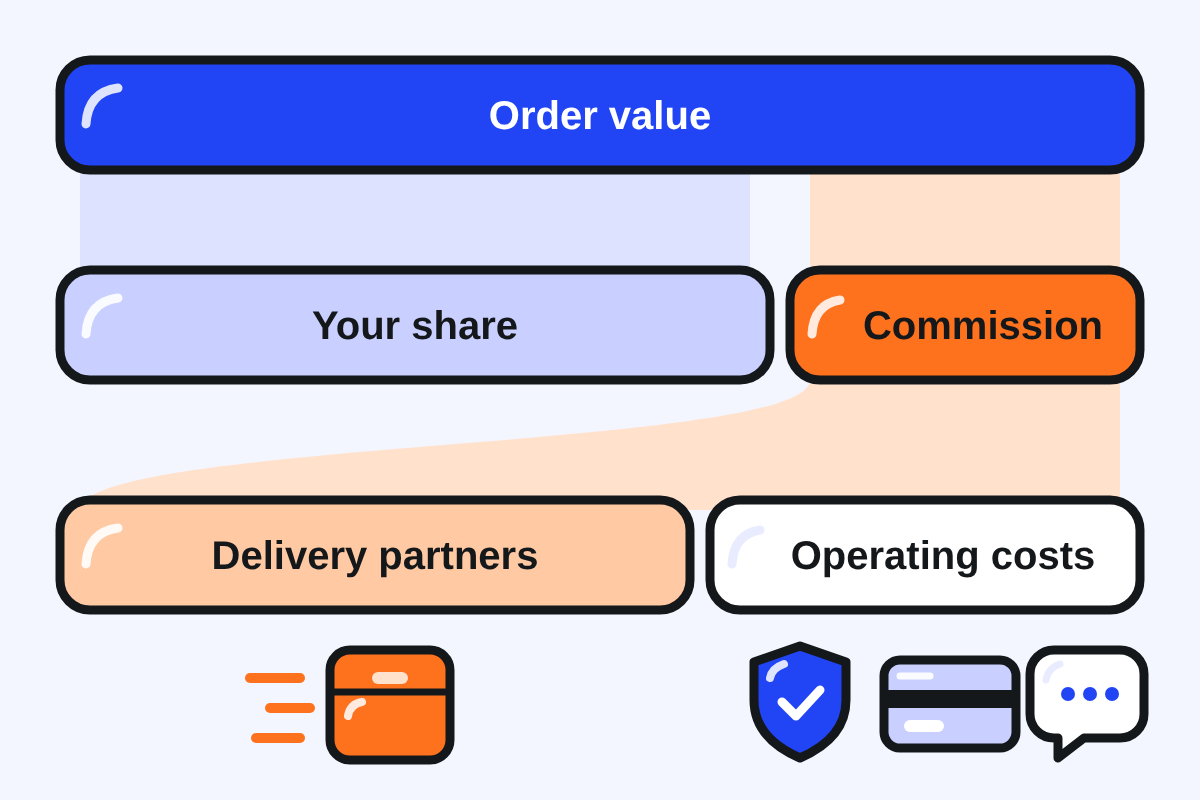
There is a point here where the sources disagree. Grab presents card charges as something it pays out of the commission13. The vendor guide lists 1.5% to 3% for credit card transactions as an additional cost for restaurants14. Both cannot describe your account at the same time. Look at your statement: if there is a separate line for card or payment fees, it sits on top of the commission. If there is none, it does not.
Is VAT added on top of the GrabFood commission?
This is the question owners ask most often. Grab does not publish the terms of its standard merchant contract, so the public sources in this guide do not say whether the rate in your own contract is quoted before or after VAT. We will not guess how your contract is written.
Where Grab has published its terms, the answer is plain. In its terms for the Kon La Krueng Plus scheme with GrabFood, Grab states that the service fee, the scheme's commission, does not include 7% VAT, and that the merchant pays it15. On that scheme, a 9% rate therefore cost 9% of the order plus 7% VAT on that 9%: 0.63 points more, or 9.63% in all. Grab writes its other charges the same way: on its page about the small order fee, a charge paid by customers, every amount is given excluding service charge and VAT16.
If your contract follows the same pattern, the VAT is a cost on top of the rate you see.
What to do:
- Read the commission clause in your contract and note whether the rate is described as including or excluding VAT. If it says nothing, ask Grab before you assume either.
- On your statement, look for a VAT line next to the commission. If there is one, add it to the commission when you work out what Grab really takes from each order.
- Ask your accountant how that VAT is treated in your books. That depends on your business, not on Grab.
What other costs can sit beside the commission?
The commission is not the only deduction a restaurant can see. The vendor guide lists optional promotional fees ranging from 5% to 15% for featured placements17. Those are your choice. Before you join a paid placement or a campaign, write down what it adds on top of your commission, and compare it with the orders it brings. Spending on visibility can be the right decision. It is a better decision when you know what it costs per order.
What were the reduced rates for Kon La Krueng Plus?
Grab Thailand announced a reduced commission for the government's Kon La Krueng Plus co-payment scheme on October 20, 202518. The headline rate was 7% for merchants who registered early, on November 319. Merchants who joined from November 4 onwards were offered 9%20. The rate applied to Kon La Krueng Plus orders21, meaning the orders paid through the scheme, not every order on the account. Registration ran from November 3, 2025 until December 31, 202522, so this campaign is closed. Grab's terms for the scheme set narrower dates than the announcement: 7% for merchants who registered on 3 and 4 November 2025 only23, and 9% for those who registered from 5 November to 19 December 202524. Where an announcement and the terms differ, the terms are what you agree to.
The same package included a 30-day commission waiver for new merchants on Grab Dine Out transactions25, and access to cash loans with interest rates ranging from 25% to 33% per year depending on the loan type26. A lower commission on part of your orders does not make an expensive loan cheaper, so judge each part of a package on its own.
Grab has tied lower rates to national schemes before, and it may do so again. When the next one comes, check four things before you sign up: which orders get the lower rate, the start and end dates, whether VAT is added to the scheme rate (the 2025 announcement did not say; the terms did), and what you agree to in return.
Can you negotiate your GrabFood commission?
Grab does not publish negotiation terms in the sources this guide uses. The vendor guide says restaurants with consistent volumes, of 50 or more orders a month, can often negotiate their rate down by 3% to 8%27 (the guide does not say whether it means percentage points or a share of the rate), and recommends reviewing your platform costs every quarter and renegotiating based on your actual order volume28. Treat that as one vendor's view, not a promise.
If you want to ask, prepare the conversation like any business conversation. Bring your order history, your monthly volume and how it has changed. Ask what rate applies at your volume, and what would change it. Keep it a discussion about growing together on Grab, because that is the interest you share.
How can you make each order leave more after commission?
Because selling is not earning29. A busy month on GrabFood can still leave little behind if each order is priced like a dine-in plate. A useful first step is to break an average delivery order into its parts: real food cost, packaging, the platform commission, labour and waste30. Do it for your top sellers first.
Then price the delivery menu as its own menu. A restaurant consultant's white paper on delivery economics argues that the delivery menu needs its own prices, sometimes its own dishes, separate from what dine-in guests see31. That is how the commission becomes part of the price rather than a surprise at the end of the month.
Order size matters too. Every major delivery platform takes a percentage of every order32, so the commission rises with the bill, but your packaging and preparation time do not always rise with it. A larger order usually leaves more after both. Grab gives you a reason to aim for it: in Bangkok, Pathum Thani, Nonthaburi, Samut Prakan and Samut Sakhon33, customers pay an extra 20 baht34 when their order is under 80 baht35. Grab states that this small order fee has no effect on the restaurant's commission36, and suggests that restaurants build set menus or run promotions that raise the order value, so customers avoid the fee37.
What should you check this month?
- Your commission rate, as written in your contract.
- Your statement: the commission line, any VAT line, and any separate payment or marketing charges.
- What Grab really takes from a typical order once all of those are added.
- Your top delivery dishes: the cost of each one after commission and packaging.
- The terms of any campaign or scheme you joined, and the date it ends.
Kontimo helps people running restaurants on GrabFood in Thailand read numbers like these each month, explained in plain language, so the next decision is easier to make.