A GrabFood markup is allowed in some markets, within limits, but Grab's advice everywhere is the same price as in your dining room. The GrabMerchant app lets you set a different price for each order type, and Grab adds that it strongly recommends menu prices be the same as in-store1. Where Grab publishes a ceiling, it is 20% above in-store prices in Singapore2, 50% in Malaysia3, and a reasonable 10% in the Philippines unless your contract says otherwise4. And a markup earns you less than it seems, because the commission is taken on the higher price too.
This guide covers the six markets where Grab runs food delivery: Singapore, Malaysia, Thailand, the Philippines, Vietnam and Indonesia. Each rule below comes from Grab's own pages for that market.
What does Grab recommend for your GrabFood prices?
The same price as in your shop, in every market where Grab says anything. The menu article of Grab's merchant help centre says it in Singapore1, in Malaysia5 and in Thailand6. Vietnam's article on updating your menu or prices says it in Vietnamese: Grab strongly encourages the price of a dish on the GrabFood menu to be the same as the price in your store7.
Grab's merchant Code of Conduct repeats it. In Singapore it recommends that the price and quality of food through the Grab Merchant App are consistent with dine-ins8, and Malaysia's code says the same9. Thailand's code, in Thai, recommends that the price and quality of food in the app match what a customer gets when eating in10.
A recommendation is not a ban. You can still set a different price for delivery. But a restaurant that does should know the ceiling in its market, and what the markup actually brings in.
How much higher can a GrabFood price be in each market?
Grab publishes a figure in three markets, and only a recommendation in the others.
| Market | What Grab publishes on a delivery markup |
|---|---|
| Singapore | Not more than 20% above in-store prices2 |
| Malaysia | Not more than 50% above in-store prices3 |
| Philippines | A reasonable markup of 10%, unless your contract says otherwise, never above your price on other platforms4 |
| Thailand, Vietnam | Same price recommended, no ceiling published |
| Indonesia | Different prices for the same product not allowed |
The Philippines has the most detailed rule. Besides the 10% markup, no markup is allowed for Dine-Out and Pick-Up11: for those, the menu price must match in-store prices12. The merchant service fee, the fee Grab charges you, should not be passed on to the customer13. A breach can bring penalties based on the price difference against other platforms14, and Grab may tell customers that a restaurant's markup is without authorisation15.
In Indonesia, Grab's Code of Conduct, updated on 26 June 202316, says in its rules on menu content that showing different prices for the same product is not allowed17. It also lists negative complaints about inaccurate prices18 among the issues that lead to written education, then a reprimand, then a warning. The rule does not name dine-in, so ask Grab before you set a delivery price above your shop's.
In Thailand and Vietnam no published page sets a ceiling. Your contract with Grab may. If you do not have a copy, ask your account manager or the merchant help centre for the pricing clause of your market before you change a price.
Does a markup cover the commission?
Not by the amount it seems to. Grab takes its commission as a share of the price you set, so it also takes a share of the markup.
Singapore's merchant terms say it plainly. The price Grab works from is the retail price, including GST, of the item as published on the Grab Platform19, and what you are paid is that price less the applicable service fee20. Grab's #AskGrab post on commission, dated Monday July 12th, 202122, gives the range: on average, around 15%-30% commission on the order value21.
Take an example dish sold at 100 in your shop, and a commission of 30%. On GrabFood at the same price, the commission is 30 and you keep 70. Raise the GrabFood price by 20%, to 120, and the commission becomes 36: you keep 84. The markup of 20 brought you 14.
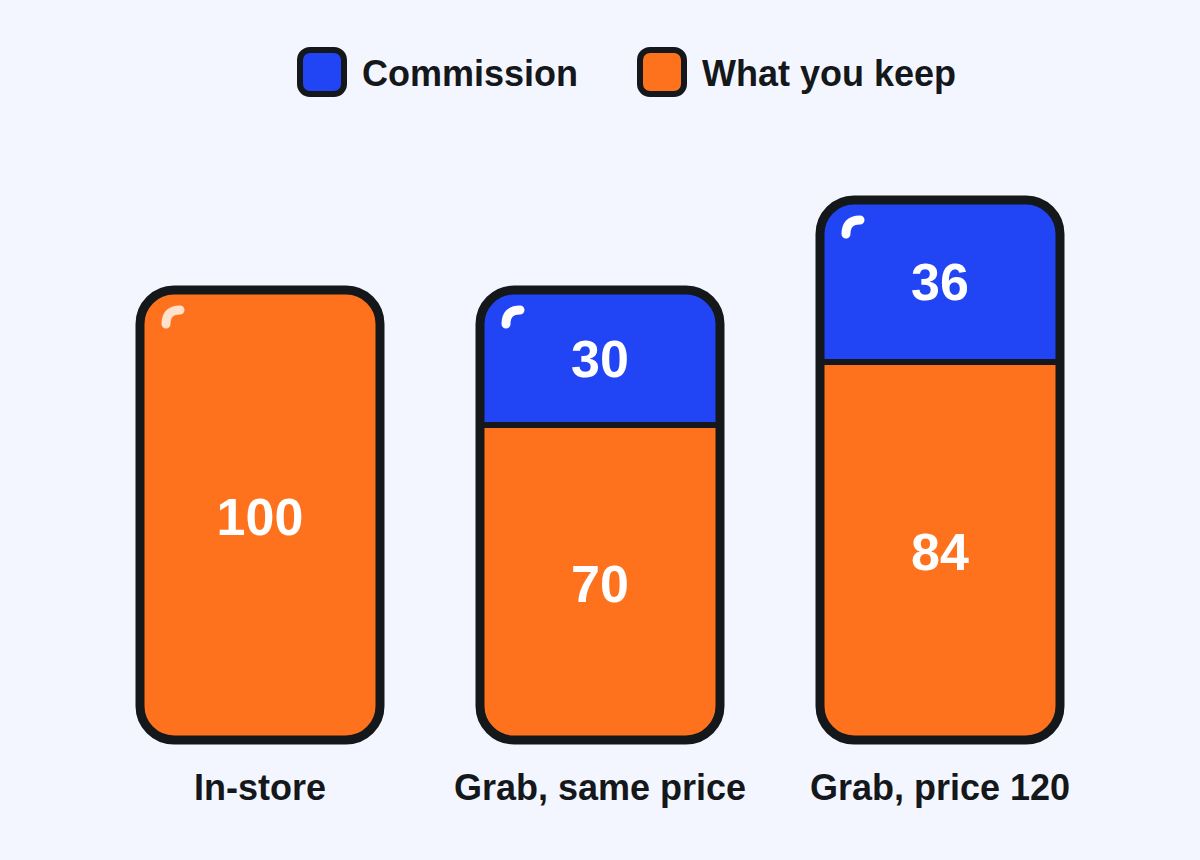
To keep the full 100 at a 30% commission, the GrabFood price would have to be about 143, a markup of 43%. That is above Singapore's ceiling and close to Malaysia's. At any commission above about 17%, Singapore's 20% ceiling cannot bring you back to what the dish leaves you in your dining room. A markup narrows the gap. It does not close it.
What can a markup cost you in orders?
Grab does not publish what a markup does to a restaurant's orders or its place in the app. Another platform has said what it sees. DoorDash told Business Insider, in an article published on 29 April 202325, that it estimates significant discrepancies in menu pricing can lead to up to 37% fewer sales and up to 78% lower reorder rates23. It also gives lower placement in its app to restaurants whose prices are higher than in-store24. That is DoorDash's own estimate, for the United States, and not a rule of Grab's. It is still a sign of what a platform can see from the customer's side.
On Grab, the cost you can count on is the customer's reaction. A customer who knows your shop price can notice a difference, and in the Philippines complaints from customers on prices must be handled by the merchant26. In Indonesia they can lead to sanctions18.
What can you do instead of a markup on every dish?
Start from what each dish leaves you on GrabFood, not from the dining room price. For each dish: the price, less the commission, less the ingredients, less the packaging. A dish that leaves too little at your in-store price is the one to work on.
Then choose the tool that fits.
- Keep the same price on the dishes customers know. Your best sellers and your simplest items are the ones a regular can compare.
- Price the delivery cost where it belongs. Packaging is a real cost of a delivery order. A dish that needs a container your dining room never uses can carry it, within your market's ceiling.
- Build items for delivery. A set or a bundle that exists only on GrabFood has no in-store price to compare with. Price it on what it costs you.
- Keep Dine-Out and Pick-Up at your shop price. In the Philippines it is a rule11; everywhere else it is where a customer compares most directly.
If you keep a markup, keep it within your market's ceiling and the same on every platform you sell on. And write down why: when a customer asks, an answer you can give is better than one you have to find.
What should you check before you set your GrabFood prices?
- Your market's rule: Singapore 20%, Malaysia 50%, the Philippines 10% unless your contract says otherwise, Indonesia no different price for the same product, Thailand and Vietnam a recommendation.
- Your contract with Grab: ask for the pricing clause if you do not hold it.
- What each dish leaves you at your in-store price, after commission, ingredients and packaging.
- What a markup really brings in: the markup less the commission on it.
- Dine-Out and Pick-Up prices at your shop price.
- Your price on other delivery platforms: never lower than on Grab if you are in the Philippines.
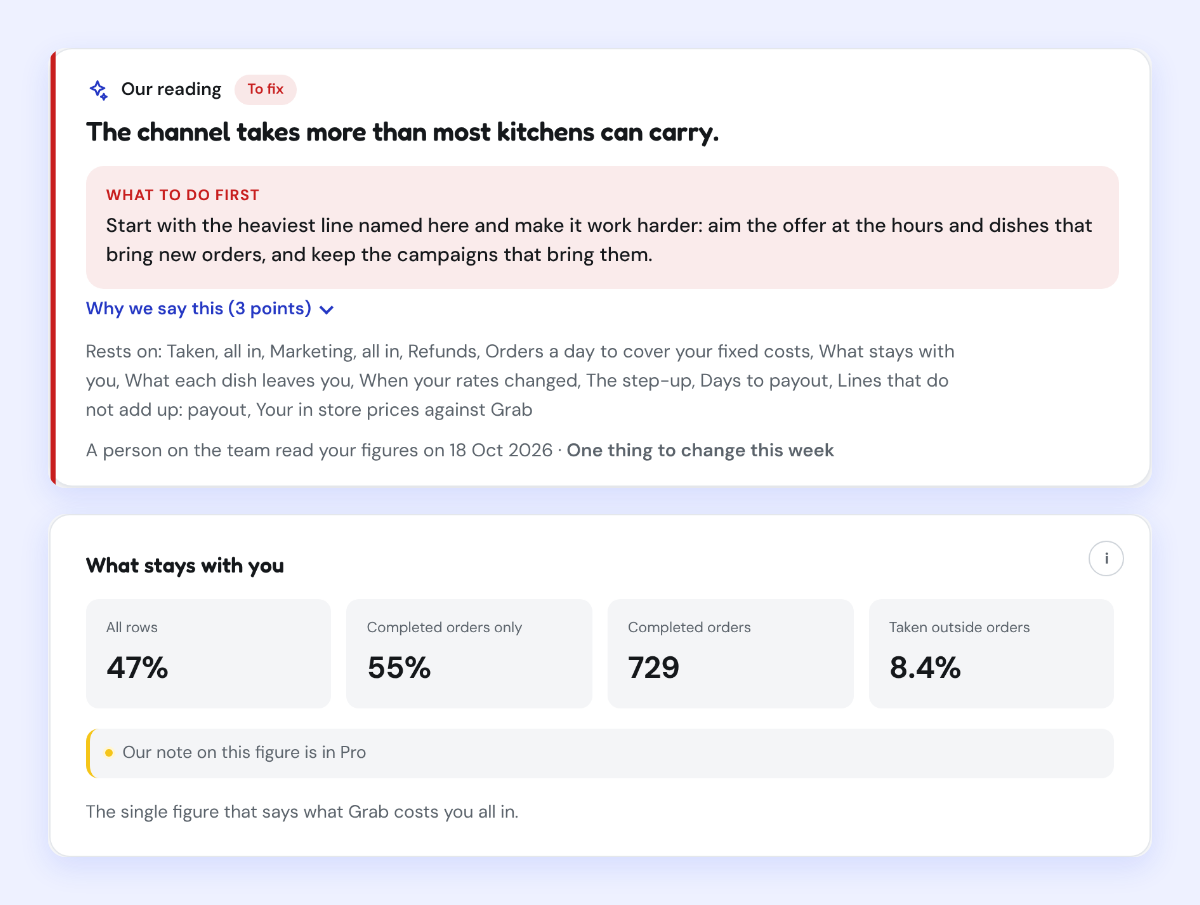
Kontimo helps people running restaurants on Grab read what each order and each dish leaves them each month, explained in plain language, so a price is set with the numbers in front of you.