Your GrabFood profit on a dish is what stays after three things come off its price: the discount you funded, Grab's commission, and what the dish costs you to make and pack. Grab's own help centre writes the first step as net sales, the order amount less the discount you funded1, and it states the commission on your reports inclusive of tax2. Your ingredients and packaging are not on any Grab report: they are yours to add. Two dishes at the same price can leave very different amounts, because the commission takes the same share of both while their ingredients do not cost the same.
This guide covers Singapore, Malaysia, Thailand, the Philippines, Vietnam and Indonesia. It uses Grab's help centre pages for each of them, and says where a market differs. The worked examples in round numbers are illustrations, not figures from any market.
What does Grab take from an order before it pays you?
Grab starts from your order and works down. Net sales is the order amount less the discount you funded yourself1. The commission comes off next. The packaging charge you set is different: Grab says it is paid by the customer and fully transferred to you3.
The longest version of the formula is Grab Thailand's: net earnings equal net sales less commission fees, adjustments, delivery fee discounts you funded, campaign commission, the marketing success fee of flash deals, advertising, loans and insurance deductions4. Grab Philippines writes it shorter, as net sales less the channel fee, which it also calls the commission, plus withholding tax5. Grab Malaysia says your net total, your earnings, is what remains after commissions, fees and adjustments are taken from net sales6. In Vietnam, the daily revenue report lists the value of each successful order with the costs charged against it7.
What to do: download one week of your financial report and find these lines on a few of your own orders. That is the only place where your real deductions are written.
How much is the commission in your market?
Grab does not publish one standard rate for restaurants in the pages this guide relies on. The rate is in your contract. What Grab has published is partial and, in places, old:
- Grab Thailand said in a post dated July 12th, 20219 that on average it charges merchants around 15% to 30% of the order value8.
- Grab Malaysia announced, during the 2021 movement control order, a reduction of its commission ceiling to 25%10.
- Grab Indonesia describes commission packages that start at 15% for its Basic class11 and at 25% for its Elite class12.
Indonesia is the one market where Grab's help centre works a commission through in figures. On an order of Rp50,000, a service fee of 20% including VAT, which is 18.01% before VAT13, leaves the store Rp40,00414. Grab adds that this is only an example15. The Indonesian figures make one point that matters in every market: Grab's reporting terms state the commission inclusive of tax2, so the rate in your contract and the amount on your report can differ by that tax. Use the amount on your report.
How do you work out what one dish leaves you?
Grab reports what each item sells, never what it costs you. So the margin per dish is a small calculation you do once, then keep up to date.
- Cost the recipe. A common formula for a dish's food cost is the ingredient cost for one serving divided by the menu price16. One vendor puts the industry range for food cost at 28% to 35% of revenue17, and a consultant's white paper on delivery argues that food cost per dish should stay at 32% at most, the same as dine-in18. Both describe restaurants in general, not a Grab market.
- Add the packaging the dish travels in. The same white paper puts packaging at USD 0.40 to 1.20 per order19, with no market named. Use your own supplier's price.
- Take the commission from the price the customer pays, at the rate on your report.
- What is left is what the dish leaves you, before rent and staff.
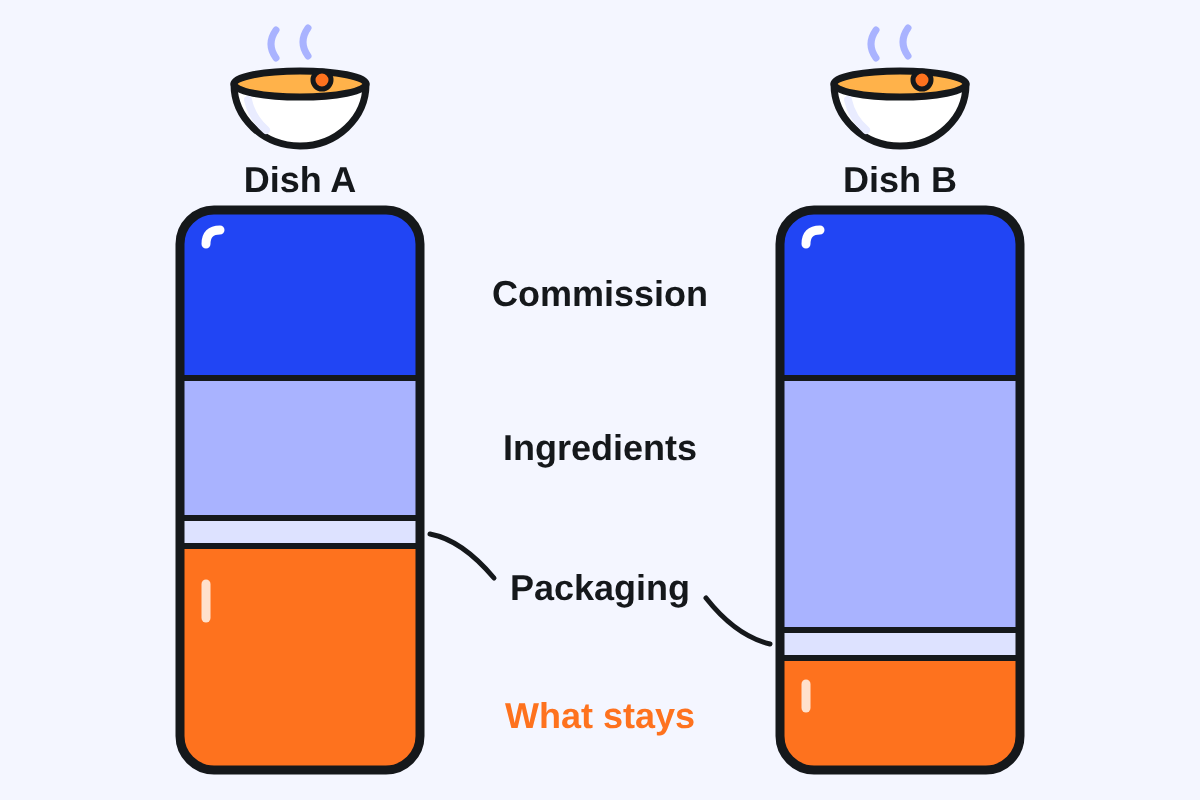
An illustration, in round numbers. Two dishes are priced at 100 each on your menu, and your commission is 30%. Each brings in 70 after commission. Dish A costs 25 in ingredients and 5 in packaging: it leaves you 40. Dish B costs 45 in ingredients and the same 5 in packaging: it leaves you 20. Same price, same commission, and dish A leaves twice what dish B does. Measured on the price, dish B's food cost is 45%; measured on the 70 you actually receive, it is above 60%. That is why a dish that works in your dining room can be thin on delivery.
The white paper reports that most operators who do this exercise find that 20% to 40% of their delivery dishes sell below their cost plus the platform fee20. Its figure comes from its own market, not from Grab's, but it is a good reason to check every dish, not only the bestsellers.
Which dishes carry your store on Grab?
Cross your margin per dish with what Grab tells you each dish sells. In Thailand, Menu Insights in the GrabMerchant app shows your top menu items by units sold, sales generated and share of sales, over up to 90 days21. Grab Singapore's help centre adds that, on the GrabMerchant portal, the Insights section has a Menu tab among its others22. Grab's item gross sales include taxes and additional charges23, so read them as what customers paid, not as what you keep.
Put the two side by side and four kinds of dish appear:
- Sells a lot and leaves a lot: these carry the store. Keep them visible, photographed well and in stock.
- Sells a lot and leaves little: a food cost guide advises looking at the recipe before making any change24. A smaller garnish, a different side or a new delivery price can fix the margin without losing the dish.
- Sells little and leaves a lot: worth promoting, in a set or as an add-on to a dish that sells.
- Sells little and leaves little: the same guide calls such a dish a candidate for removal25.
The white paper's advice for delivery menus runs the same way: raise the price or redesign the dishes that cannot absorb the commission, and retire the ones that lose margin26.
How do promotions and ads change what a dish leaves?
A discount you fund comes off before net sales1, so it comes out of the same margin you calculated above. In the illustration, a discount of 20 on dish A takes it from 40 to roughly 20 or 26, depending on whether your commission applies before or after the discount. Grab's pages read for this guide do not say which: your statement does, on an order that carried a promotion.
Campaigns can add their own fee. Grab Thailand defines a marketing success fee charged when you run a promotion in its Spotlight campaign27, and ads come off your earnings too4. None of this makes a promotion a bad idea. It means a promoted dish should be one with room in its margin, so that each extra order still leaves you something. Run your promotions on your dishes that leave the most.
How often should you check your numbers?
Ingredient prices move. If your menu prices stay flat, your food cost percentage goes up automatically28, and so does the share of each order that never reaches you. A quarterly check is a reasonable rhythm: update your recipe costs, read three months of your Grab report, and redo the margin per dish for your top sellers.
The point of the exercise is the one the white paper makes: margin per order, not volume, decides whether delivery adds to your business or takes from it29. Busy days on Grab are good news when every dish on your delivery menu earns its place.
What should you do this week?
- Download your GrabMerchant financial report and find, on five orders, the commission, any discount you funded and any campaign fee.
- Note your commission as your report shows it, inclusive of tax.
- Cost your ten bestselling dishes: ingredients and packaging, per serving.
- Work out what each one leaves after commission, and sort them from most to least.
- Compare that list with your menu insights, and decide one change: a price, a recipe or a promotion moved to a dish with room for it.
Kontimo helps people running restaurants on Grab read numbers like these every month, in plain language, so the next menu decision is easier to make.