In a Grab co-funded promotion, the discount your customer sees is paid by two parties: Grab covers a portion of it on each order, and your restaurant pays the rest. Grab describes it in its merchant help centre: occasionally Grab plans exclusive campaigns and partially funds the discount value1. How much each side pays is not a fixed rate. Grab says the breakdown is unique to each campaign and can be found in that campaign's details2. Outside those campaigns, a promotion you create yourself is funded by you: you fund the discount value of your promo for completed promo orders3.
This guide covers every market where Grab runs food delivery. Grab's help centre answers the question in the same way in Singapore, Malaysia, Thailand, the Philippines, Vietnam and Indonesia, and the worked figures below come from its Singapore and Thai pages, in their own currencies.
How do you know a promotion is co-funded?
Co-funding is shown on the campaign before you join it. If a Spotlight Campaign includes co-funding, a "co-fund" tag appears in the details of the campaign4. In Singapore, Grab says the co-funding details are in the Payment section of the campaign details page5. Grab says the same in the Philippines6, in Vietnam, where Grab funds part of the discount on each order7, and in Indonesia, where Grab's own example reads "Grab ikut mendanai 40%"8, Grab co-funds 40%.
Spotlight Campaigns are the campaigns Grab hosts and invites selected stores to join from the Marketing tile of the GrabMerchant app. A promotion you build yourself (a whole order discount, an item discount, a free item, a bundle) carries no co-funding.
What to do: open the campaign's details and find the split before you join. Write down two numbers: the share of the discount Grab pays, and the share you pay.
Who pays what on each order?
Grab works one example through in its Singapore help centre. The campaign gives 25% off with a minimum spend of $8, capped at $5, and Grab co-funds 40%9. Twenty orders of $15 each come in. The discount on all of them adds up to $7510. Grab pays $30 of it11, and the restaurant pays $4512.
Per order, that is a discount of $3.75 for the customer: $1.50 paid by Grab and $2.25 paid by you. The customer sees one discount. You pay 60% of it.
The same campaign also charges an advertising fee. Of the 20 orders, 10 came through advertising placements13, and those 10 cost $0.50 each, $5 in all14. Grab's example ends with $250 left from $300 of orders15.
Read that $250 with care. It is what remains after the discount and the campaign's fees. Grab's example does not take off your commission, your packaging or your food cost. What an order leaves you is what remains after all of them.
What else can a Spotlight campaign charge?
The discount is not the only cost. Grab's Singapore page lists two fees. A marketing fee is charged only on orders where the promo was applied16. A variable advertising fee is charged on orders generated through campaign assets17, even if no promo was applied, and the amount can vary based on bidding18. Some campaigns work differently: for Sales Boosting campaigns, Grab charges a campaign fee on all orders generated during the campaign period19, not only on the orders that used the offer.
Leaving is not always immediate either. Some campaigns have a minimum participation period that you have to meet before you can leave20.
In Thailand, Grab's recommended promotions carry no fee to join, other than the cost of the promotion the restaurant pays21. Grab adds a warning: before the campaign starts, cancel the whole order discount and delivery fee discount promotions you created yourself22, or Grab cancels them for you automatically23.
What to do: before you join, list every fee the campaign names (marketing fee, advertising fee, campaign fee), on which orders each applies, and the minimum period you commit to.
Is your commission charged on Grab's share of the discount?
Grab's help centre does not answer it for a co-funded order, and the answer changes what each order leaves you. Singapore's merchant terms come closest.
For a promotion your business funds, Grab Thailand's help centre is clear: your commission is calculated after deducting the promotion discounts funded by your business24, and so is the restaurant tax25. You are not charged commission on the money you gave away.
Grab's share is treated the other way. Grab Singapore's merchant terms, last modified on 23 August 202426, define the price Grab works from, the Relevant Price, as the price after discounts provided or funded by the merchant27. They add that discounts provided or funded by Grab are not taken into account in it28. What the merchant is paid for the goods is that Relevant Price less the service fee29. Read together, the price your Singapore commission is measured against is the order less your own share of the discount, with Grab's share still inside it.
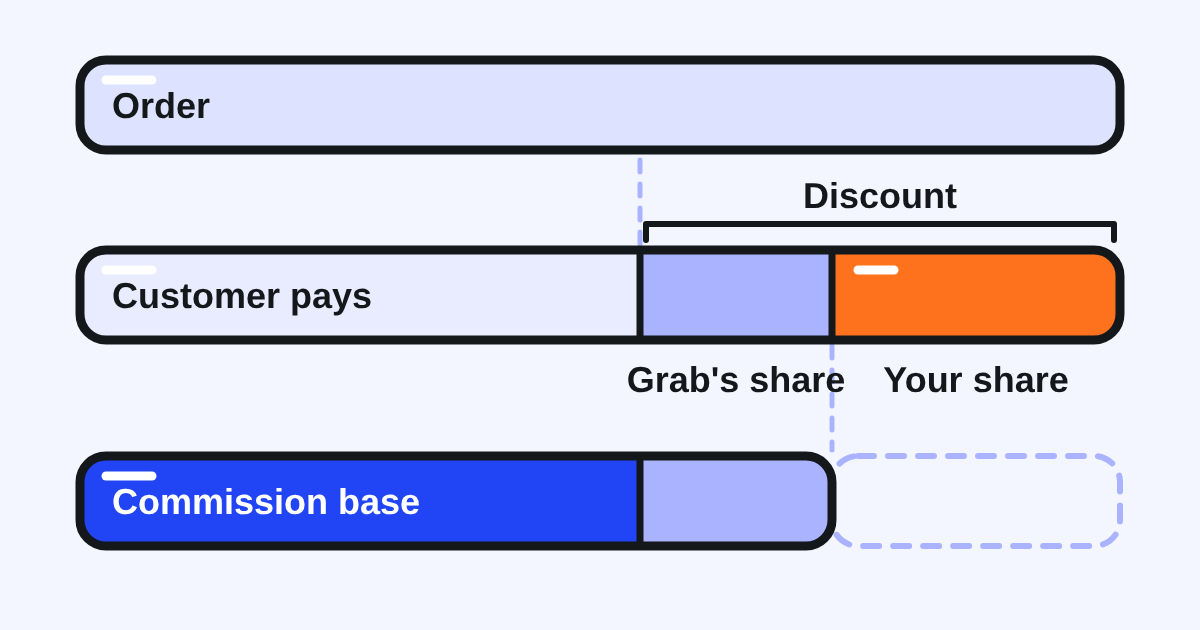
Grab's other examples point the same way. On Dine Out, Grab's example takes a 15% discount on a ฿100 bill, 10% funded by the restaurant and 5% by Grab, and charges its 5% fee on ฿9030: the bill less the restaurant's share only. In Singapore, a percentage marketing fee is worked out on the order less a discount the merchant funds31, and Vietnam states the same rule for its percentage fee32.
On the $15 order above, that means a commission base of $12.75 (the order less your $2.25), not $11.25 (the order less the whole discount). The customer paid less, and your commission is still taken on the part Grab paid for. Grab's share still reaches you as part of the price you are paid, so this is not a charge on nothing, but it is a cost to count when you judge the offer.
Outside Singapore, no page we hold says. What to do: ask Grab, before you join, how the commission is calculated on a co-funded order in your market, and check it on your statement after the first week. Take one co-funded order, find the commission line, and divide it by your rate: the result is the base Grab used.
Are there promotions Grab funds in full?
Sometimes, for a limited number of orders. In Singapore, Grab offered selected new outlets a welcome pack in which the funding is limited to the first 20 redemptions per outlet33. Grab funds the discount value only, and a $0.30 marketing fee is charged per successful order34. Once the Grab funding is used up, the campaign automatically becomes a merchant-funded campaign35. From that point you pay the full discount, so the date to watch is the one on which your twentieth redemption arrives.
National schemes have carried co-funding too. In Thailand, Grab's package for a government scheme, announced on October 20, 202536, included a programme where Grab co-funds promotional discount worth up to THB 10,000 per merchant37. That campaign is closed. When the next one comes, read its cap: a fixed amount per merchant means the co-funding stops when the amount is spent, whatever the end date of the campaign.
How do you read a campaign's assisted sales beside its cost?
The campaign report in the GrabMerchant app shows assisted sales: the total sales driven by this campaign38. Beside it sits return on spend: how much you earned compared with the total marketing spend of the campaign39. Only successfully delivered orders count in either figure40.
Two cautions. Assisted sales are the value of the orders, not what they left you: a $15 order counts as $15 of sales whatever its discount, commission and food cost. And Grab does not say, in the pages we hold, whether the spend in a co-funded campaign's report counts your share of the discount only, or Grab's as well. Return on spend is a useful comparison between your own campaigns. It is not a margin.
What to do: for each campaign, put three numbers side by side. The orders it brought, what you paid for them (your share of the discount plus every fee), and what those orders left after commission, packaging and food cost. A campaign is worth repeating when the third number is above what the same days brought you without it.
Should you join a co-funded campaign?
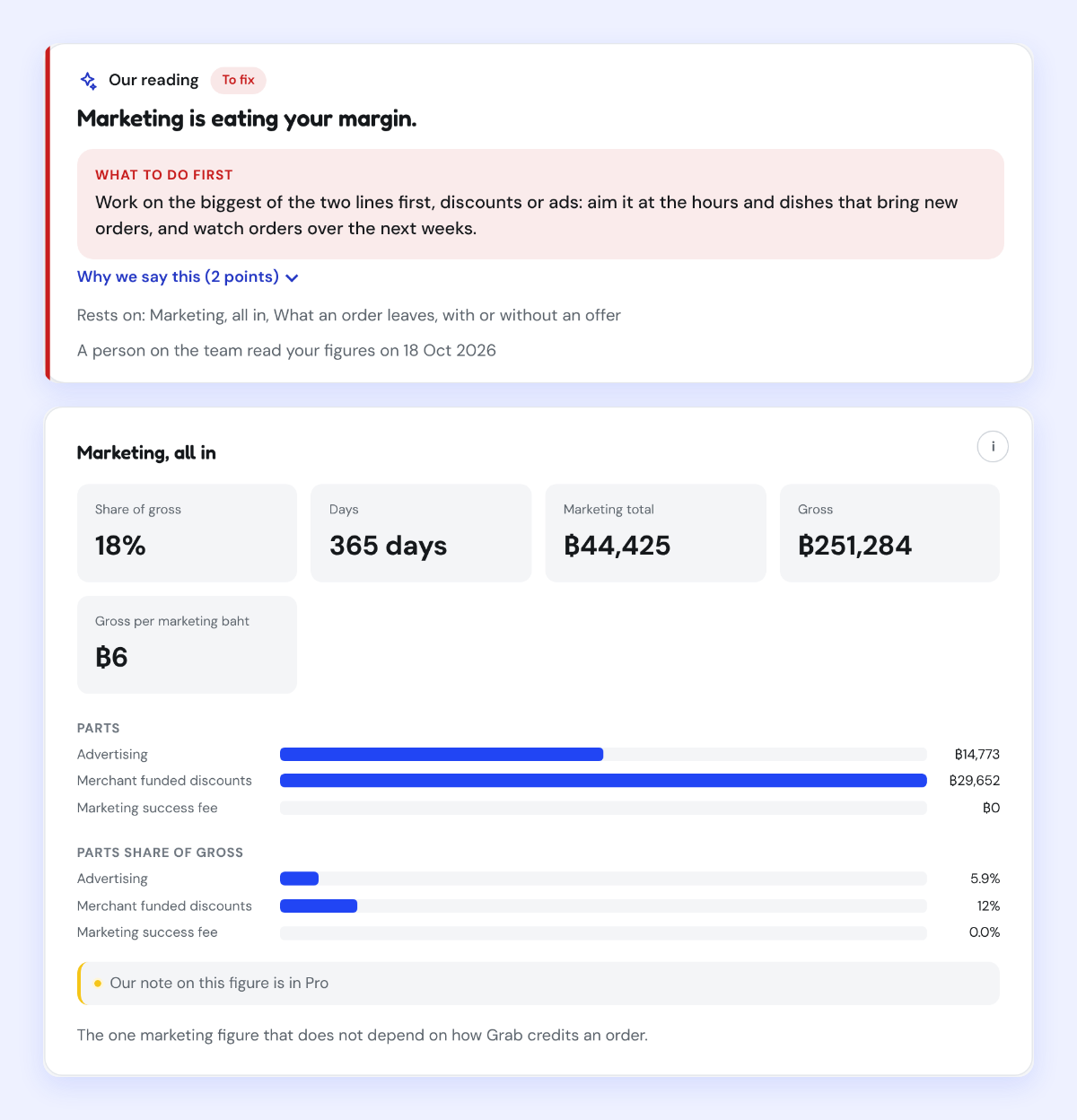
A co-funded discount lets you offer your customers more than you pay for. On Grab's example, the customer sees $3.75 off and you fund $2.25. That is a stronger offer for the same spend, and Grab also says, in its help centre, that running ads and promotions together can get up to 15% more promotion redemptions, according to its internal research41.
It is a good use of your budget when the offer suits your menu: a minimum spend your customers already reach with a main and a drink, a cap that keeps the discount on large orders within reason, and a period you can staff. It is worth a second look when the campaign's fees apply to every order, when the minimum period is long, or when the offer would replace a promotion of your own that was already working.
What should you check before you join?
- The co-fund tag, and the split: Grab's share and yours.
- The minimum spend and the cap of the offer.
- Every fee: marketing fee, advertising fee or campaign fee, and the orders each applies to.
- The minimum participation period, and how long leaving takes.
- Whether your own promotions will be cancelled while the campaign runs.
- How the commission is calculated on a co-funded order in your market: ask, then check one order on your statement.
- After the campaign: the orders it brought, what you paid for them, and what they left after commission and food cost.
Kontimo helps people running restaurants on Grab read their campaigns and statements each month, explained in plain language, so the next offer is chosen with the numbers in front of you.