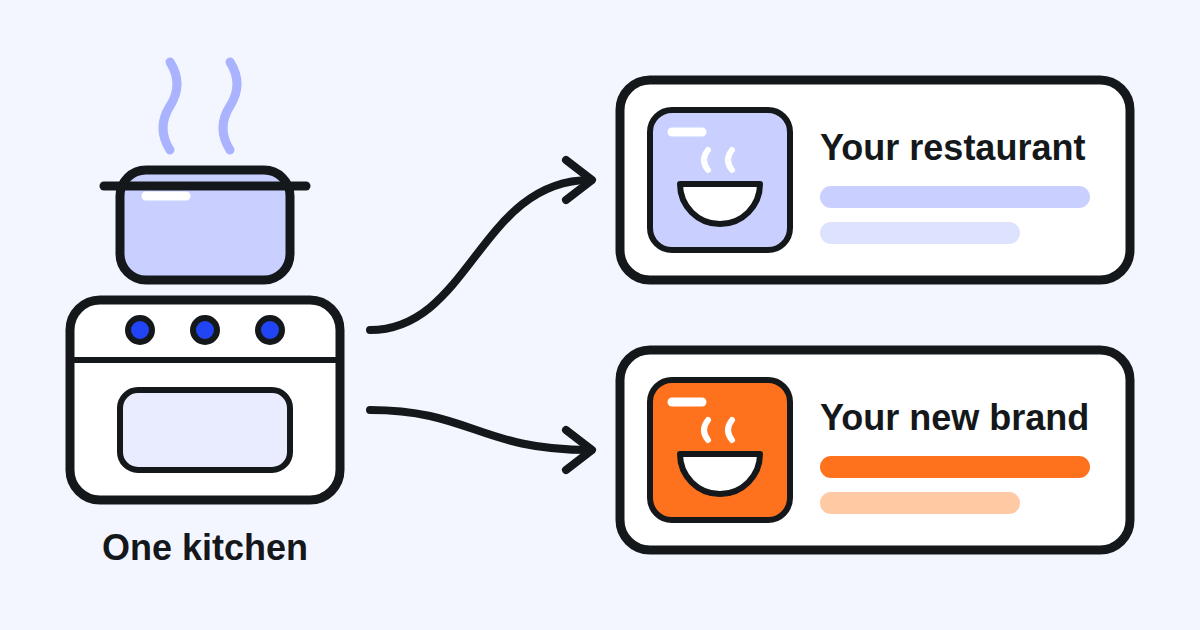
A virtual brand is a delivery-only restaurant brand cooked in a kitchen you already run: a second shop in the app, with its own name, menu and photos, and no dining room of its own. DoorDash, which publishes guidance on the model, defines a virtual restaurant as a delivery-only brand run from an existing restaurant's kitchen1. On Grab, the way to open one is to register an additional outlet. Grab does not publish a page on virtual brands as such, but its Malaysian help centre speaks to the case directly: its article on additional outlets is written for merchants expanding their business or launching a new brand2, including outlets under a different brand or business name3.
This guide covers Singapore, Malaysia, Thailand, the Philippines, Vietnam and Indonesia, where Grab's help centre describes how a merchant already on Grab adds an outlet. The steps differ by market, and the guide names each.
What is a virtual brand, and how is it different from a cloud kitchen?
Three words are often mixed up. A virtual brand (or virtual restaurant) is the concept and its menu, cooked in your existing kitchen1. A ghost kitchen is a standalone kitchen with no storefront, built only for delivery and pickup4. A cloud kitchen is a shared facility housing several operators5. A virtual brand can run from your own kitchen or from a ghost or cloud kitchen; this guide is about the first case, a second brand from the kitchen you have.
Why would a restaurant open a virtual brand?
To sell more from what it already pays for. A U.S. Chamber of Commerce article from May 20216 describes virtual brands as tightly focused, easy menus that travel well and use the labour and fixed costs a restaurant already has7. One operator quoted in it put it plainly: the rent is the same, the lights are already on and the staff is already in the kitchen8. The same article reports that a US chain's virtual burger brand helped bring in extra sales at off-peak times9, and that it was adding about $900 a week in sales per restaurant, with profit margins in the mid-20% to low-30% range10. Those are American chains in 2021, at the height of pandemic delivery. They show what the model can do, not what it will do for you.
Grab has hosted the model itself. When it opened its first GrabKitchen cloud kitchen in Singapore, in a release dated January 9, 202011, Grab described it as an experimental platform for merchants to introduce new food concepts and brands with significantly reduced risks12, and the site opened with over 10 brands, including three new virtual restaurants13.
A virtual brand is worth a look when your kitchen has quiet hours and spare capacity, when the dishes you would sell under the new name use ingredients you already stock, and when customers nearby search for a kind of food your current listing does not show.
How do you list a virtual brand on Grab in your market?
As an additional outlet, through the process for merchants already on Grab. Malaysia's article says it in so many words: if you are completely new to Grab, you register through the merchant registration page instead14; if you are already a merchant, you add an outlet.
- Malaysia. You submit the outlet through Grab's form, logged in with the Owner or Manager role15. Grab asks for the header of a recent bank statement, photos, a menu and a brand logo, with at least 5 food photos16 and the brand's logo17. The list also asks for 1 storefront photo18: a delivery-only brand has no storefront of its own, so ask Grab what it accepts before you apply.
- Singapore. You may register only one outlet when you first sign up19. Once your first store is live, you add more in the GrabMerchant app, from the store list page, under "Add Stores"20. You may apply for up to 5 outlets in one application, and your first application must be approved and completed before you can add more21.
- The Philippines. In Metro Manila, you may visit the Grab Merchant Center for in-person help22; if you cannot, you file a ticket23. The list of requirements includes a store logo of 750x750 pixels24, the menu and its photos. Grab says the process usually takes a few days, depending on document verification25.
- Vietnam. You fill in Grab's form, and Grab's sales team calls you within 1 to 3 working days to guide you through the next steps26. The request is processed within 5 to 7 days of Grab receiving everything it needs27. For individual partners and household businesses, a new merchant package applies when a new branch is registered in certain areas28, priced from 290,000 VND29 to 1,200,000 VND30 depending on the area. A company signs a contract appendix instead31.
- Indonesia. You must already be a GrabFood partner to add a new outlet32. The form asks for a photo of your ID card (Foto KTP33) and a selfie.
- Thailand. The help pages we read do not describe an additional outlet. They do set the rule that matters: the store name must be related to what you sell, and a change of product type means applying for a new store, not renaming the old one34. So a new concept is a new store. Grab Thailand also runs GrabKitchen cloud kitchens in 14 service areas, 13 in Bangkok and one in Chiang Mai35, open only to GrabFood merchant partners36, if you would rather start the brand outside your own kitchen.
What to do: before you apply, write to Grab through your merchant account and say what you plan, a second brand cooked in the same kitchen, at the same address. Ask how it should be registered in your market and what Grab needs from you. Grab's pages we hold do not say how it treats two brands at one address, and that answer belongs to Grab.
What does Grab not allow?
Two lines in Grab's merchant code of conduct apply directly. Grab asks merchants not to cheat or defraud Grab or its customers, and gives sharing or creating duplicate accounts as an example37. It also asks for truthful information when you create and access your account38. A virtual brand is a new shop with its own menu, registered through Grab's process; it is not the same menu listed twice under two names.
The same honesty applies to what customers see. Grab strongly recommends appropriate and truthful photos of the items you sell, rather than images not belonging to you39, and it reviews store names to prevent brand impersonation40: the new brand's name, logo and photos have to be your own.
How do you run two brands from one account?
From one place. Grab Singapore says that several stores can be run from a single GrabMerchant account41, with a view of all stores or of one. Each employee is given a role and the stores they can access42, so your kitchen team can see the orders of both brands. When you run an ad across several stores, its cost is deducted from the store where the orders are placed43. In the Philippines, Grab says all branches can be managed under one account, and that each branch has its own profile for orders and operations44.
That last point is the one to plan for. Each shop has its own orders and its own operations to keep up, and the new brand builds its own record from its first order, while your first shop's record still depends on the same kitchen.
What should go on the new brand's menu?
What your kitchen already does well, under a name that says it. DoorDash's guidance points to a virtual restaurant when a kitchen has open capacity45, and to a short menu of around 15 to 25 items, so the kitchen moves fast and quality holds steady46. The operator quoted by the U.S. Chamber describes the ideal case: carrying a couple of extra ingredients to turn on a whole new restaurant using the one you already have47.
Pick the name with the app in mind: easy to spell and easy to find, since customers will look for it on apps and search engines48. Then test it. Order from your new brand as if you were a customer and check what arrives at the door49.
Before you launch, check what each order of the new brand would leave you. DoorDash's method: start with your average order value50, take what remains after the ingredients, then subtract the platform commission and your per-order packaging cost51. If the result is positive, the brand adds money. If it is negative, more orders will not fix it.
What should you check before you open one?
- The quiet hours of your kitchen, and how many more orders it can cook without slowing your first shop.
- Which dishes would form the new menu, and whether they use what you already stock.
- What Grab needs in your market: the form or the app, the documents, a logo, the food photos, and any fee.
- Grab's answer, in writing, on registering a second brand at your address.
- What each order of the new brand leaves after ingredients, commission and packaging.
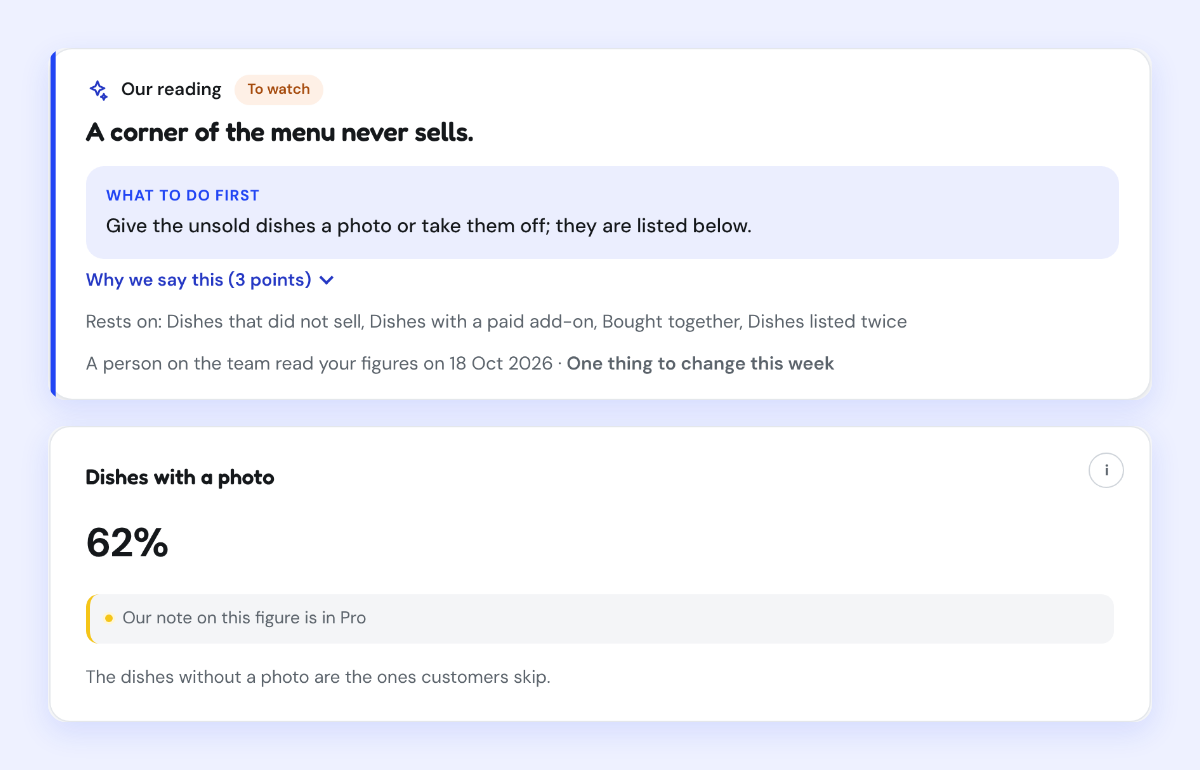
- A month after launch: the new shop's orders, its first reviews, and whether your first shop's times held.
Kontimo helps people running restaurants on Grab read each shop's results month by month, explained in plain language, so a second brand is judged on what it really adds.