A free item and a discount are both a GrabFood promotion you can create yourself in the GrabMerchant app, and they do not cost you the same. A discount costs you the money taken off the order. A free item costs you what it takes to make and pack the item, which is less than its menu price. In exchange, a free item comes with a minimum order, Grab describes it as a free item from your menu when a minimum order is met1, and in the one study that counted, fewer customers took it up. Choose the free item when you want to lift orders up to a threshold with something your customers already want. Choose the discount when you need the offer to reach as many customers as possible.
This guide covers the six markets where Grab runs food delivery: Singapore, Malaysia, Thailand, the Philippines, Vietnam and Indonesia. Grab's article on creating a promotion is the same in all six, and the figures below are examples, said as such.
What promotions can you create on GrabFood?
Five types, from the Marketing tile of the GrabMerchant app: a whole order discount, a delivery fee discount, an item discount, a free item, and a bundle. The list is the same in every market.
The free item always comes with a minimum order. Grab's Singapore example reads "Get a free apple for a $10 minimum order!"3. Malaysia's article says to offer free items with a minimum order value4, Indonesia's says the same in Indonesian5, and Vietnam's example is a free drink on orders from 200,000 dong6. A whole order discount also asks for a minimum order. An item discount does not.
Whatever the type, a promotion makes your store more visible. In Singapore, Grab says restaurants that run promotions automatically receive a promo tag and are featured in the Deals Around You highlights in GrabFood7. And in Thailand, one item can only have one active promotion at a time8, so the item you give away cannot also carry an item discount.
What does each promotion cost you?
In every market, you pay for what you give away. In Thailand, Grab says you pay for the discount amount from the promotion9.
Outside Thailand, Grab's article adds a fee. In Singapore, you fund the discount value and are charged a marketing fee on successful orders10, although, for a limited time, the marketing fee for your own promotions is free of charge11. In Malaysia12 and the Philippines13, you pay the discount value and a marketing fee. Vietnam's example charges a fee of 100 dong an order14, and Indonesia's article names the discount value and a promotion fee15. Cancelled and unused promotions carry no marketing fee16.
Grab's articles name the fee for every promotion type alike. What changes between a free item and a discount is the cost of the offer itself, and the commission.
Why does a free item cost less than a discount of the same value?
Because of two things: the commission, and the difference between a menu price and a cost.
A discount lowers the commission with the price. In Thailand, your commission is calculated after deducting the promotion discounts funded by your business2. In Singapore, Grab's merchant terms take the price after the discounts you fund17 as the price the commission is measured on.
Take an example order of 200, a commission of 30%, and an offer worth 40 to the customer.
- A discount of 40. The customer pays 160. Your commission is 30% of 160, 48 instead of 60, so 12 of the 40 is commission you no longer pay. The offer costs you 28.
- A free item priced 40 on your menu. The customer pays 200 and receives the item as well. Since the free item is a promotion you fund, its value is deducted before the commission, which stays at 60 on the 200 the customer paid. You pay nothing more to Grab. The offer costs you what it takes to make and pack the item: in this example, 14.
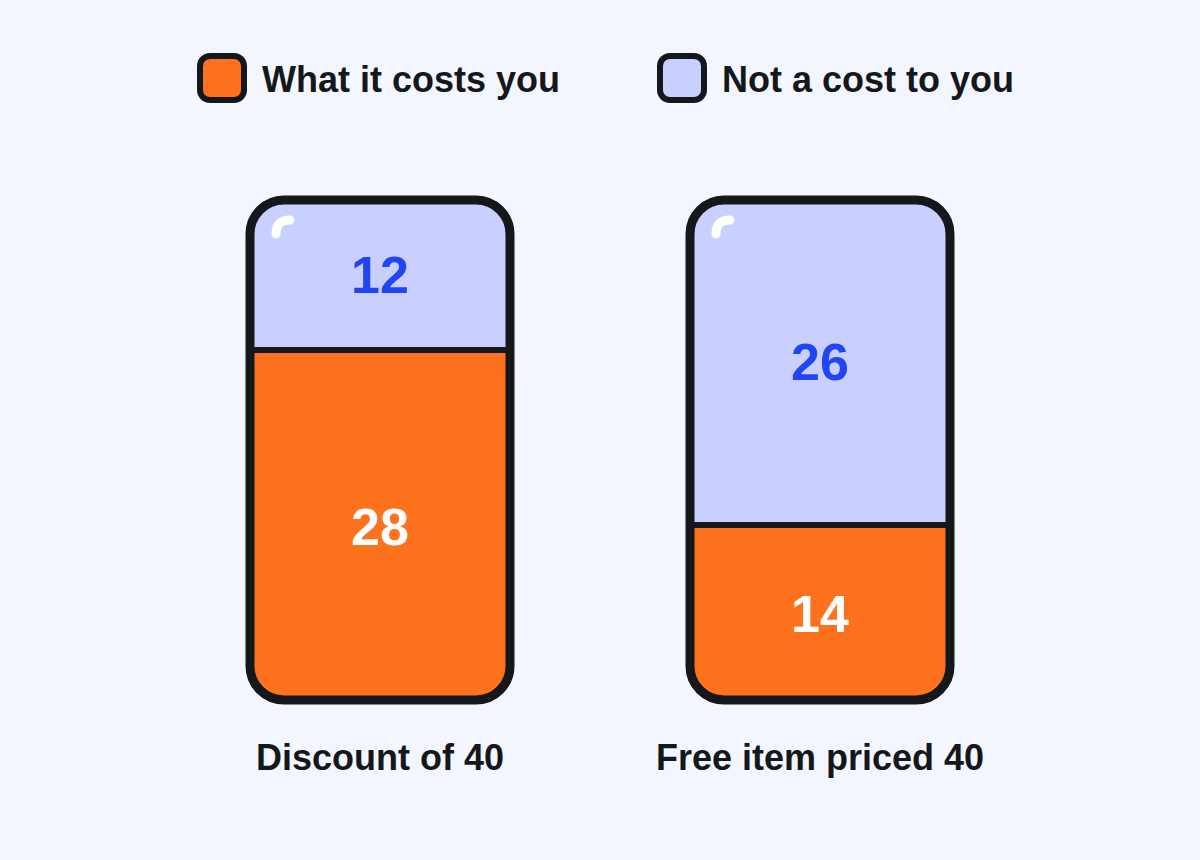
The free item is the cheaper offer whenever what it costs you to make is below about 70% of its menu price at this commission. Work it out for the item you have in mind. Grab's pages do not say what value a free item is recorded at on your statement. Check it on the first order that carries one: the commission on that order should be the same as on an order of the same value without the offer.
The catch is the other half of the bar. The 26 is not a cost to you, but it is not value to the customer either unless they wanted the item. A discount of 40 is worth 40 to everyone. A free drink is worth 40 only to the customer who would have bought that drink.
Which one do customers take up?
In the one study that counted, the discount. There is no published comparison on Grab. The closest is a study by Food Standards Scotland, in the United Kingdom, which followed 106 orders between August and November 202418. Discounts with a minimum spend appeared 86 times and were taken up 47% of the time19. Free items appeared 34 times and were taken up 15% of the time20.
The same study says why. The free items were mostly drinks, and where they were taken up, the free drink came with meals the customer was already planning to order21. Where they were not, the free item was not something the customer wanted, or it needed a minimum spend they did not reach22.
How you frame the gift also matters. Research by Liu, Wei, Yang and Keh found that presenting the product the customer is after as the free gift makes consumers feel lucky and raises their intention to buy23. On a delivery menu, that points to giving away something people come to you for, not the item that does not sell.
When should you choose a free item, and when a discount?
A free item fits when
- you want to raise orders to a minimum: the free item rewards the customer who adds a dish to reach it;
- you have an item that costs little to make and that customers want: a drink with a meal, a dessert, a side;
- you want customers to try something: a new dessert given away gets tasted.
A discount fits when
- you need to bring in new customers, who do not yet know your menu and will not value a free item they have never seen;
- your orders are already above the minimum you would set, so a threshold changes nothing;
- you want one simple offer that every customer understands.
Whichever you choose, set the minimum order a little above your usual order, so the offer asks for one more item. And set a limit: Grab lets you restrict how many times a customer can use the promotion24.
How do you know if your promotion worked?
Compare the days with the promotion and the same days without it, over at least two weeks each. Three numbers: how many orders came in, the average order value, and what the orders left you after commission, the offer and the food cost. A free item that lifted the average order to the minimum and cost you little has worked. A discount that brought the same orders you already had has only lowered your price.
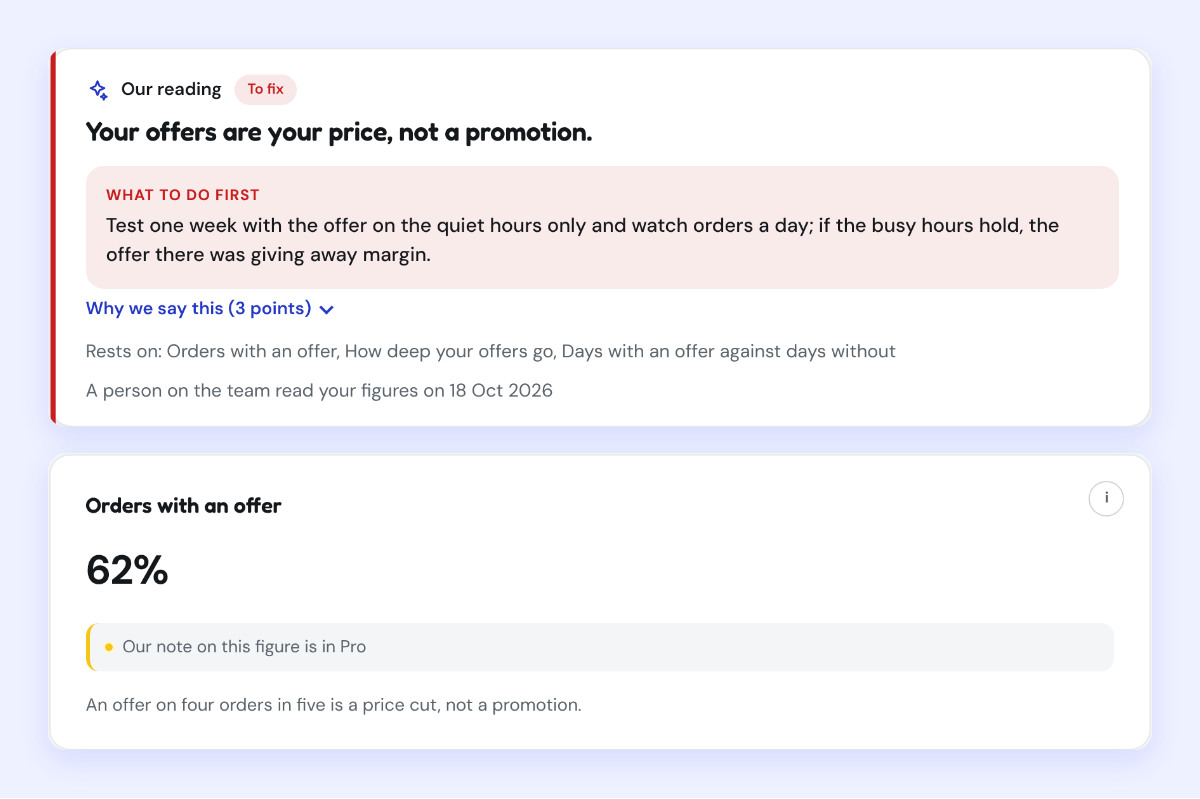
Watch how many orders carry the offer too. When most of them do, the offer is no longer a promotion: it is your price.
What should you check before you choose?
- The type: a free item with a minimum order, or a discount on the order, an item, the delivery fee or a bundle.
- What the offer costs you: the money off for a discount, the cost to make and pack for a free item.
- The marketing fee in your market, on the promotion's review screen before you create it.
- The minimum order: a little above your usual order.
- The redemption limit per customer.
- After two weeks: orders, average order value, and what the orders left you, with and without the offer.
Kontimo helps people running restaurants on Grab read what their promotions bring and cost each month, explained in plain language, so the next offer is chosen with the numbers in front of you.