
The Phuket low season arrives with the rain and with fewer foreign visitors. In 2026 the Thai Meteorological Department declared the rainy season open from 15 May1, and the Bank of Thailand counted 3,263.80 thousand foreign visitors to Thailand in February2 against 1,841.55 thousand in June3, both preliminary figures. A restaurant on GrabFood cannot change the weather or the flights. It can plan: measure its own season, open the hours it can staff, keep the dishes its low season customers order, prepare for rain, and choose promotions and ads for the people still in town.
This guide is for restaurants in Phuket and Thailand's other tourist areas. The Grab tools it names are those of Grab's Thai help centre.
When is the Phuket low season?
Phuket counts three seasons, not two. A Prince of Songkla University study of fine dining restaurants in Phuket puts it this way: seasonality divides into low season, green season, and high or peak season4, and the peak normally starts in December5. The national pattern is the same: the first quarter is Thailand's high season and the second is not6.
The rain sets the start. In its 2026 announcement, the Meteorological Department expected rain to increase from mid May to mid June, with heavy rain likely in places in the eastern region and on the southern west coast7, the coast Phuket sits on. Across the country, it expected the rain to return in force in August and September8. The sources this guide relies on give no official end date for the rains on the southern west coast, so treat the end of the low season as something to read in your own sales, not from a calendar.
The low season is not empty either. In a briefing on January to May 2025, reported by the press, Phuket's tourism authority counted 5,859,022 arrivals9: 1,591,817 Thai visitors and 4,267,205 from abroad10. The same report noted more visitors from the UK, Germany and France during the green season11. Who stays in town changes with the months, and so does who orders from you.
What to do: write down the months of your own low season from your sales, not from a travel guide. The next section shows how.
How do you tell the season from a real drop in sales?
A fall in June against March may be nothing but the season. The question that matters is whether this June is worse than last June.
The same Phuket study found that demand moved slightly differently in Phuket Town and on the beaches, which reflects their different clients, namely the locals and tourists12. A beach restaurant that serves visitors and a town restaurant that serves residents do not have the same low season, so your own figures are the only fair measure.
Statisticians measure a season with a seasonal index: the average for that season divided by the average of all the data13. For a restaurant, take your monthly GrabFood sales for the last two years, average each calendar month, and divide by the average month. A result above 1 is a month above your average; below 1 is a month below it.
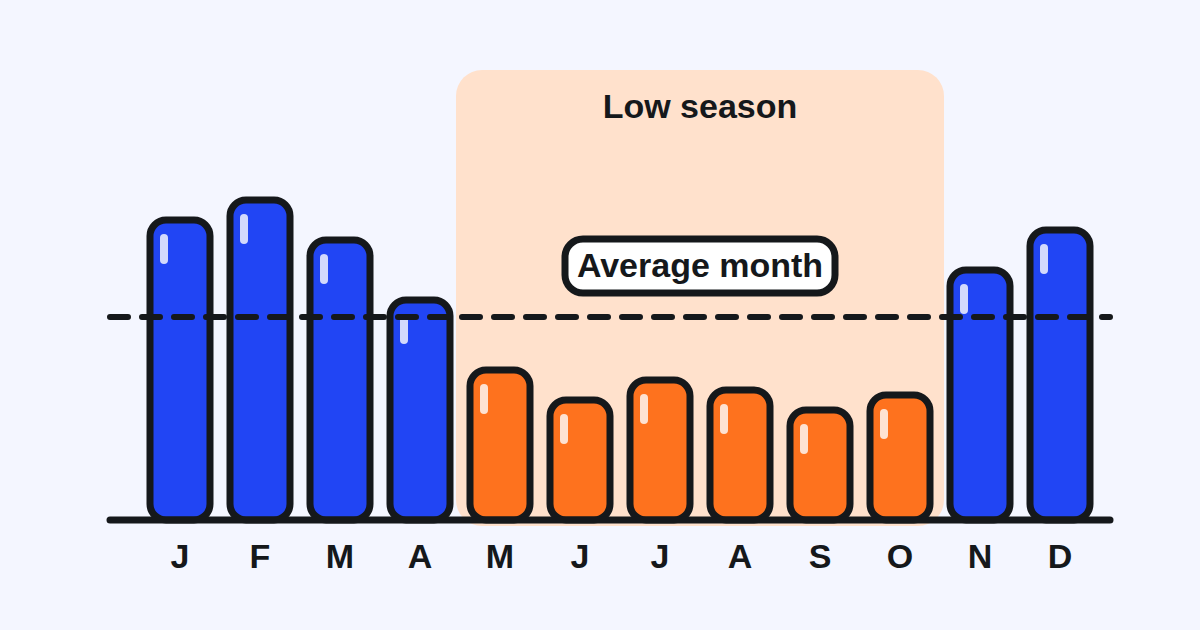
Then compare like with like. A report on Thailand's tourism in 2026 put it plainly: the comparison that carries information is second quarter against second quarter14. Official statisticians remove the season for the same reason, to take out calendar-related variation15. If your June orders are close to last June's, the drop is the season. If they are well below, something else changed: your rating, your menu, a competitor, your prices. That is worth looking at while there is still time.
Should you close or stay open in the low season?
The restaurants in the Phuket study mostly stayed open: in both town and beach locations, they commonly remained open for business during periods of low customers16. Staying open on Grab does not mean opening every hour of the high season, though. Open the hours you can staff well, so that every order that comes in is cooked and sent on time.
GrabMerchant gives you three tools for this:
- Regular hours. You select the days of the week and adjust their operating times17. Use them when your low season week is shorter, for example no lunch on quiet weekdays.
- Special hours. These schedule holiday or temporary closures without changing your regular hours18. The app applies them on the dates you choose and returns to your regular schedule afterwards, with no manual reset19. You can set them up to 3 months ahead20, keep up to 5 periods at once21 and use up to 3 time slots a day22. A two week break for repairs or for your team's holiday belongs here.
- Pause. It stops new orders for 30 minutes, 1 hour or 1 day, and your restaurant shows as "temporarily closed" while it runs23. It is for a rush or an incident, not for a season.
What to do: before the season turns, set your low season hours as regular hours, and book any closure as special hours, so customers never find you open with nobody in the kitchen.
How should your menu change for the low season?
When sales fall, costs and stock become the problem. The Phuket restaurants interviewed said the operation cost became a major issue when the revenue dropped, followed by the awareness of raw material usage24. A shorter menu buys fewer ingredients and throws away less.
On GrabFood you do not need to delete dishes to do this. The availability schedule lets you set selling dates and time slots for a menu, which helps you optimise inventory and ensure your customers see the right menus at the right time25. A dish made for the high season can be given a schedule for the months it sells. For a dish you stop for a while, the "Out of Stock indefinitely" status keeps the dish unavailable until you add it again26.
What to do: list your dishes by orders in last year's low season months. Keep the ones that sold, put the others on a schedule, and check that each remaining dish still uses ingredients you buy anyway.
What happens to your deliveries when it rains?
Rain can shrink the area your restaurant delivers to. Grab's help centre in Malaysia explains it: factors like heavy rain, storms or severe traffic can temporarily impact delivery supply and efficiency, reducing the serviceable area27. Grab Thailand's help centre does not publish this page, so it does not say whether Thailand works the same way; the system it describes is Grab's own. If you seem to disappear from the app during a storm, Grab's advice is to wait 30 minutes and check your store's visibility again28.
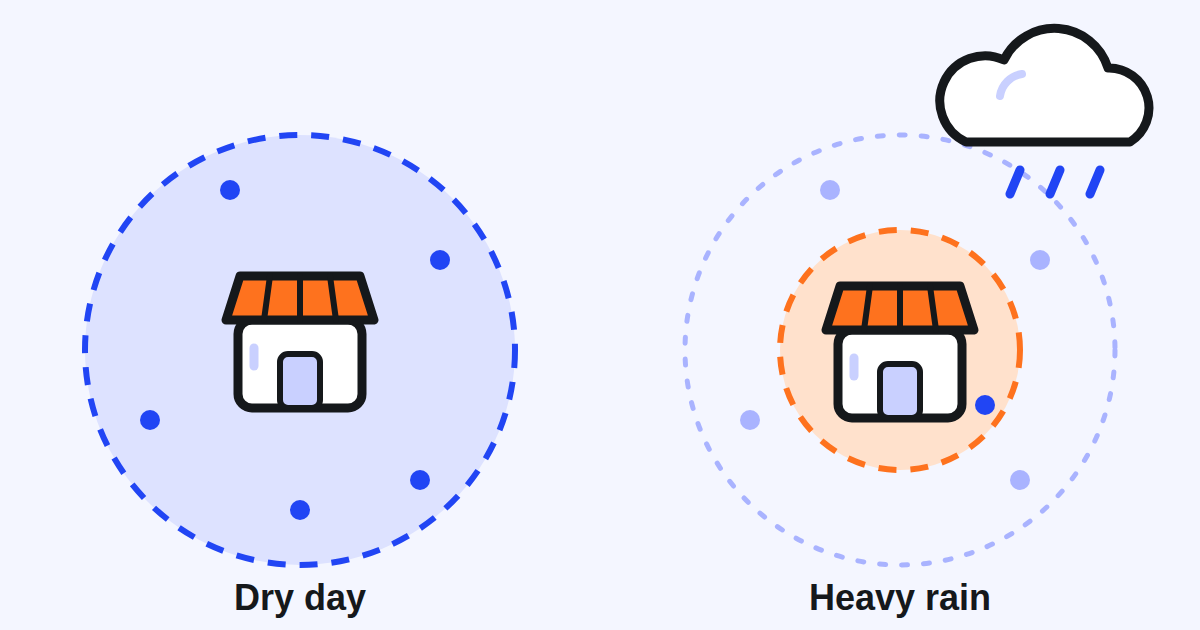
Grab's answer to a smaller radius is to encourage scheduled orders and self pick-up29. Both exist in Thailand. Grab asks you to start preparing a scheduled order only when it appears in the Now tab30, so you cook it when its slot comes. Self pick-up lets a customer order in the app and collect the food from your restaurant when it is ready31, which suits neighbours who live too close to need a rider.
What to do: on rainy evenings, keep the kitchen ready for scheduled orders, and tell regular customers nearby that they can collect in person.
Which promotions fit a quiet season?
A promotion in the low season has one job: to bring back the customers who are still in town. Grab's promotion settings let you adjust customer criteria and redemption limits32, so you choose who can use the offer and how many times.
Two settings deserve care. If no end date is set, Grab's page on creating a promotion says it runs for 180 days33, while Grab's promotion FAQ says a promotion cannot last longer than 60 days34. Whichever applies, set the end date yourself, on the last week of your low season, so a low season offer does not run into December. And a promotion needs to be planned at least one hour before it starts35.
For ads, Grab's audience tool tells customers apart by when they last ordered. Active customers placed at least 1 order with you in the past 90 days36. Inactive customers placed their last order more than 90 days but within 180 days ago37. In June, your inactive customers last ordered roughly between December and March. Some were tourists who have gone home; some are residents who stopped ordering. An ad aimed at them can reach the residents; the tourists among them will not order until they come back.
Is advertising cheaper in the low season?
Grab says it is, in general. Its Thai help centre explains that ad prices are set by an auction, and in general you pay more when ads are in demand, and less during off-peak hours and seasons38. You set the most you will pay for a click or an order, and the actual amount you are charged can be lower than your set limit, depending on competing bids39.
That does not mean every advertising baht does more in June. A cheaper click from fewer customers can still bring few orders. Keep your bid at what an order is worth to you after commission and food cost, and judge the campaign by the orders it brings, month against the same month last year.
What should you check before your next low season?
- Your monthly sales for the last two years, and the months that fall below your average month.
- This low season month against the same month last year: the season, or something else.
- Your regular hours for the low season, and any closure booked as special hours.
- Your menu: the dishes that sold last low season, and a schedule for the rest.
- A plan for rainy evenings: scheduled orders and self pick-up.
- Each promotion's audience, redemption limit and end date.
- Your ads, judged by orders, against the same month last year.
Kontimo helps people running restaurants on Grab read numbers like these each month, explained in plain language, so a quiet season is planned rather than suffered.