Repeat customers on GrabFood are won first by the first order: a customer comes back when the food arrived as promised, then because something reminds them of you. Grab counts a repeat customer as one who has placed more than one order with you in the past 90 days1, and its own merchant blog puts it plainly: attracting new consumers is great, but keeping them is where real growth happens2. This guide explains how Grab counts your customers, what makes a first order turn into a second, and the tools Grab offers to bring customers back: the Loyalty Stamp Card, ads aimed at your past customers, and messages to members of your loyalty programme.
It covers every market where Grab runs food delivery: Singapore, Malaysia, Thailand, the Philippines, Vietnam and Indonesia. Not every tool exists everywhere, and the guide says where Grab documents each one.
How does Grab count a new, a repeat and an infrequent customer?
Grab's reporting terms sort your customers into three groups. A new customer has placed their first order with you3. A repeat customer has placed more than one order with you in the past 90 days1, the same definition in Thailand4. An infrequent customer placed an order with you after more than 90 days of not ordering from you5. Your total customers are the three added together6.
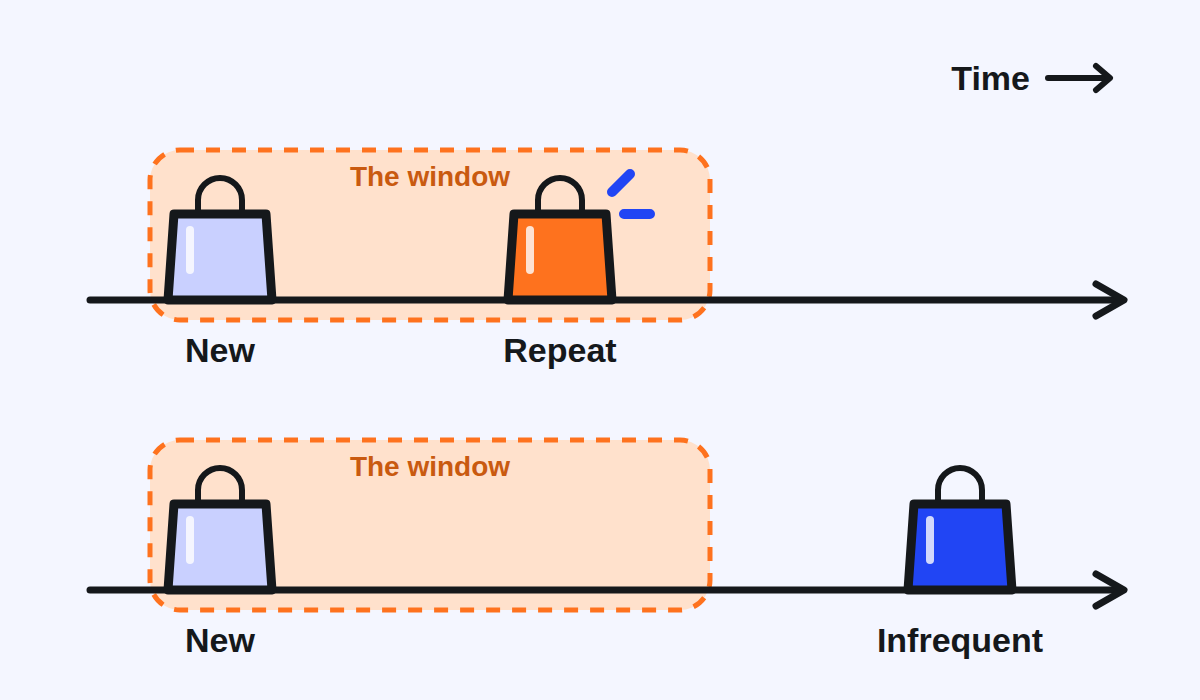
Grab's advertising tools use a close set of words with a second limit. In Marketing Manager Pro, active customers have placed at least one order with you in the past 90 days7, and inactive customers are those whose last order was more than 90 days but within 180 days ago8. Indonesia9 and Vietnam10 use the same 90 and 180 days.
What to do: read your customer report with these words in mind. The 90 days are the window that matters. A customer who has not come back within it is no longer a repeat customer in Grab's report, and after 180 days Grab's ads no longer count them as your inactive customer either.
Why does the second order matter so much?
Because it is where most customers are lost, and where the ones who stay start to pay back what it cost to win them. Grab publishes no figure for the share of a restaurant's customers who come back. The nearest figure for the region comes from another delivery platform in Singapore: in a report published on Thursday 16 May 202411, Time Out Singapore wrote that, on 2023 data, the food brands on Deliveroo kept 45 percent of their customer base doing repeat orders12, and that one in four delivery orders came from people who had ordered from the same eatery at least two to three times13. In the United States, DoorDash cites its own 2026 report with SevenRooms, which found that repeat diners spend 27% more than first-time diners14.
Neither figure is a GrabFood figure, and neither tells you what your own share should be. What they do say is that a restaurant whose customers come back once rarely has to buy every order again.
What makes a first-time customer order again?
The first order itself. Grab's advice to merchants starts there: keep your packaging sturdy so food arrives looking as good as it tastes15, and stay consistent, so that every repeat order feels the same. A customer who received a soggy box or a missing side dish does not come back for a stamp.
Then the follow-up. Grab adds that responding to reviews, good or bad, shows that you care16, and that a small personal touch, such as a note saying "Thank you for ordering again"17 in the packaging, can make your store stand out18.
When something did go wrong, fix it before the customer leaves for good. In Thailand, Grab lets customers message your restaurant about an order for up to 3 hours after their order is completed19. Grab presents the chat as a way to quickly resolve issues, clarify misunderstandings, and protect your shop's rating20. A missing item replaced the same evening is often the order that brings the customer back.
What to do: before thinking about rewards, take your last twenty first-time orders and check what happened to them: the reviews they left, the incidents reported, the items marked missing. The answer to "why do they not come back" is usually there.
How does Grab's Loyalty Stamp Card work for delivery orders?
The Loyalty Stamp Card is Grab's own loyalty programme for restaurants. Grab describes it as a feature that rewards customers with stamps for both delivery and in-store orders21. On GrabFood, customers earn stamps automatically when an order meets the minimum spend, delivery and service fees excluded22, and they can see their progress in the Stamp cards section before confirming their order23. Only one stamp is issued per transaction, whatever the total spend24.
Grab Singapore's page describes how it works there: customers earn stamps only when they order from you and are rewarded at the end of 5 transactions25, and Grab can also send reminders about their stamps and remind them to order again from you26. The reminder is sent by Grab, which is how the card keeps reaching customers who know you only through GrabFood.
On cost, the same Singapore page, as it read on 21 October 2026, offers each GrabFood merchant a one-time 6-month free trial27, and states a fee of S$30 per outlet per month after it28.
Indonesia works differently. Grab Indonesia says the programme is available on a limited basis and that the GrabFood team contacts selected merchants to join29. Customers there redeem their reward only in your restaurant30, and a reward is valid for 30 days from the day it is earned31. A delivery-only kitchen should ask how a customer would redeem before joining. In Thailand, the Philippines and Vietnam, Grab's help centre listed no article on the Stamp Card on 21 October 2026, so ask your Grab contact whether it is offered in your market and on what terms.
What to do: set the minimum spend at a basket your regular customers already reach, not above it, so the card rewards the orders you have rather than asking for bigger ones. Choose a reward that costs you little and that customers value, such as a side or a drink. Then check how many orders carry a stamp: in Malaysia, transactions with loyalty stamps end with "L"32 in your order history.
How do you reach customers who stopped ordering?
With ads aimed at them, or with messages to the members of your loyalty programme.
Ads. The basic Marketing Manager in the GrabMerchant app offers 2 targeting options33: all customers or new customers, in Thailand's comparison. Reaching your own past customers is done in Marketing Manager Pro, where you can refine your audiences by active customers, lookalike customers and inactive customers34. An ad aimed at inactive customers reaches the people who ordered from you between 90 and 180 days ago8: customers who know your food and have drifted. Grab adds one exception: audience targeting is not recommended for search ads35, which reach whoever searches.
Messages. Grab Customer Management, its CRM, is available to merchants with an active Grab Loyalty Program36. It sorts the customers of your loyalty programme into groups, including an inactive group of customers who ordered previously but have not recently37, and sends them WhatsApp messages with an optional promotion. Only customers who have given consent can be targeted38: those in your loyalty programme who consented to marketing and have WhatsApp installed39. Grab's own advice is to tailor the offer to the group, for example a win-back for inactive customers and early access for frequent ones40. Messages are paid for in credits whose price varies by package41, and Grab asks you to contact your Account Manager to enable it42. Grab's help page describes it in Singapore, Malaysia, the Philippines and Indonesia.
What to do: start with the group closest to coming back, the inactive customers of the last six months, with an offer worth a second look and a clear end date. And send little: Grab's own guidance on frequency is to avoid fatigue43.
What about an offer only for repeat customers?
Grab's reporting terms name a return offer, an offer for repeat customers44, so you may see the term in your reports. No help page stored for this guide says how a restaurant creates one in any market. If your Marketing Manager shows it among the offer types, it is the tool made for this case; if not, the stamp card and the inactive audience above do the same job.
What should you check each month?
- Your customers split three ways in Grab's report: new, repeat and infrequent. The repeat share is the one to watch over several months.
- The first orders that went wrong: reviews, incidents and missing items of first-time customers, and whether they were fixed.
- If you run a stamp card: how many orders carry a stamp, and how many customers reached the reward.
- If you run ads to inactive customers: how many of them ordered again, against what the ads cost.
- Your messages: one offer at a time, to one group, with an end date.
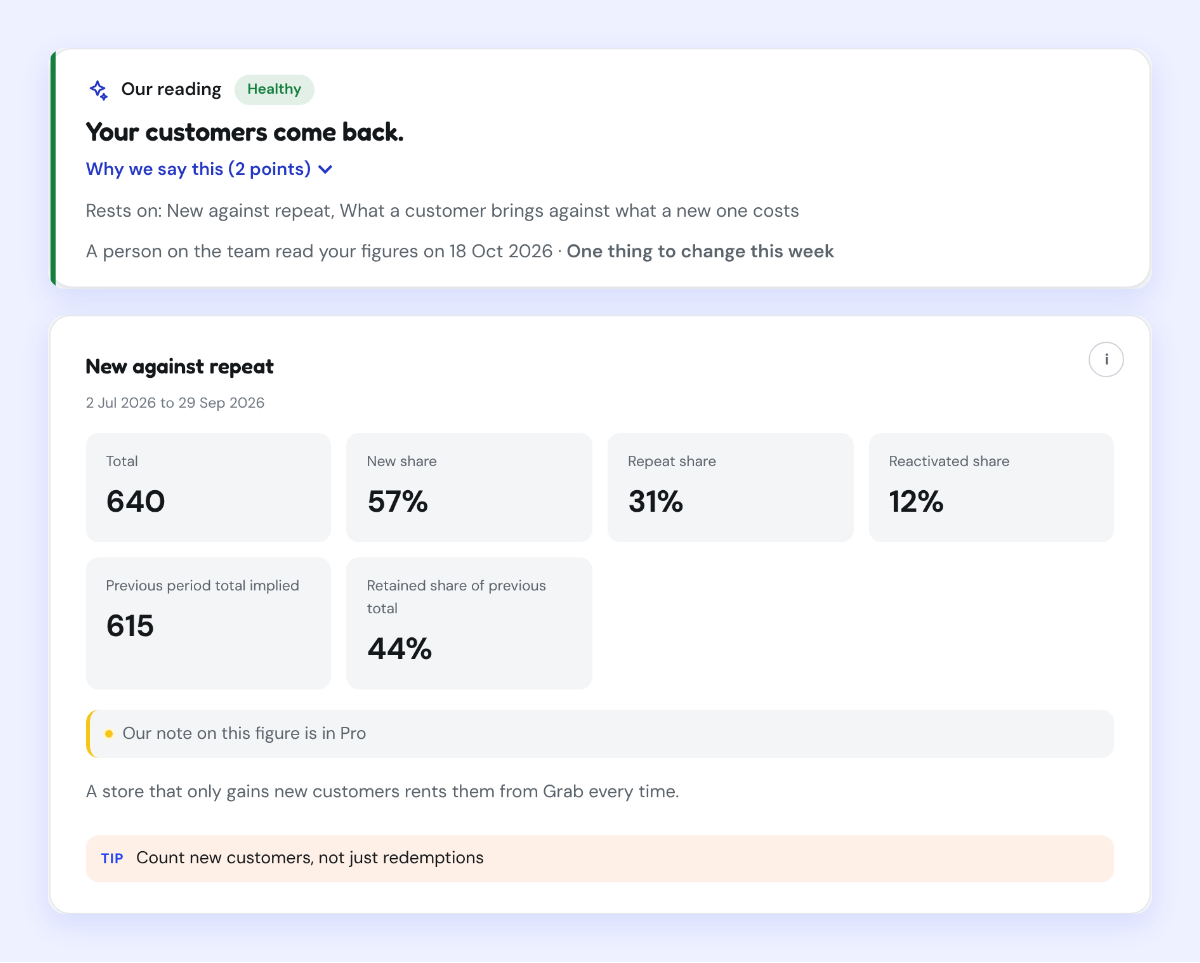
Kontimo reads a restaurant's GrabFood customer reports each month, and says in plain language how many customers came back, how many were new, and what each one cost to win.